Back Extension (45° Hyperextension)
Safety Rating for 40+
Benefits for 40+
The back extension on the 45° bench specifically strengthens the lumbar muscles and posterior chain with controllable, self-limiting load. For 40+ trainees, strong spinal erector muscles are crucial for vertebral stability and fall prevention. The exercise complements McGill's core endurance philosophy by training extension control. Simple progression via weight plates enables conservative increases – appropriate for the slowed tendon adaptation after 40.
Form Cues
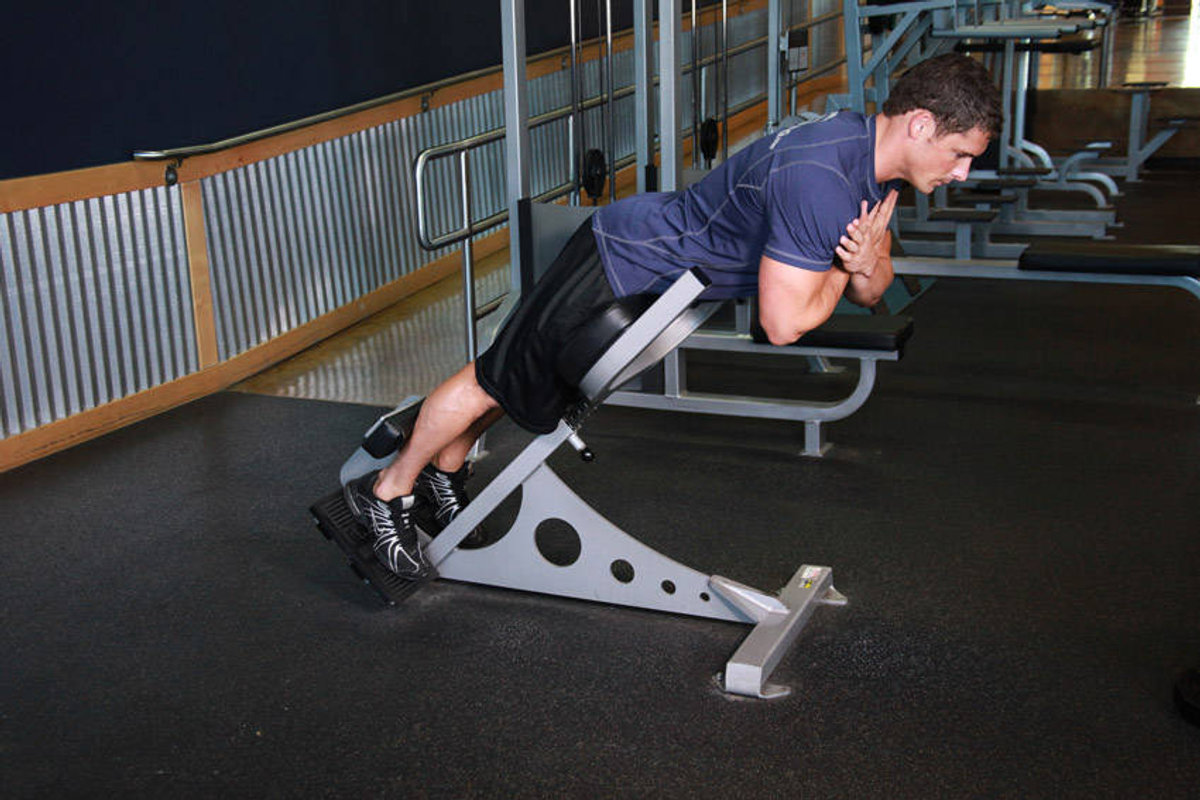
- Thighs on pad, hinge at the hips – not at the back
- Lower and raise under control – don't hyperextend past horizontal
- Cross arms over chest or hold weight plate for progression
Common Mistakes
- Extending past horizontal ('hyperextension') – compresses facet joints and endangers the lumbar spine
- Fast bouncing up and down – creates uncontrolled peak loads in the lower back
- Holding weight behind the head instead of at the chest – increases lever arm on the cervical spine
- Rounding the back at the bottom instead of hinging at the hips
Modifications
Beginner
Start without added weight, arms crossed over chest. Only lower as far as the hip hinge allows with a neutral back. 12–15 reps, focus on controlled tempo.
For Joint Issues
For back issues: significantly reduce ROM – only 30–45° instead of full lowering. No added weight until pain-free. For spinal stenosis: caution as extension can compress the stenosis – get medical clearance. Alternative: bird dog as a more back-friendly lumbar strengthening option.
Advanced
Hold weight plate at chest for progressive overload. Tempo: 3 sec lowering, 2 sec hold at horizontal, 2 sec rising. Single-leg variation for increased stabilization demand.
Scientific Basis
Isolates lower back and posterior chain with controllable load. Important: Don't extend past horizontal (despite the name 'hyperextension'). Ideal as a supplement to compound hinge exercises for targeted lumbar strengthening.
Contraindications
- Acute herniated disc – the extension movement can worsen the prolapse
- Spinal canal stenosis – hyperextension compresses the spinal canal and can provoke neurological symptoms
- Spondylolisthesis – extension can worsen vertebral slippage
- Acute facet joint irritation – the end position in extension directly loads the facet joints
Related Exercises
Related Guide