
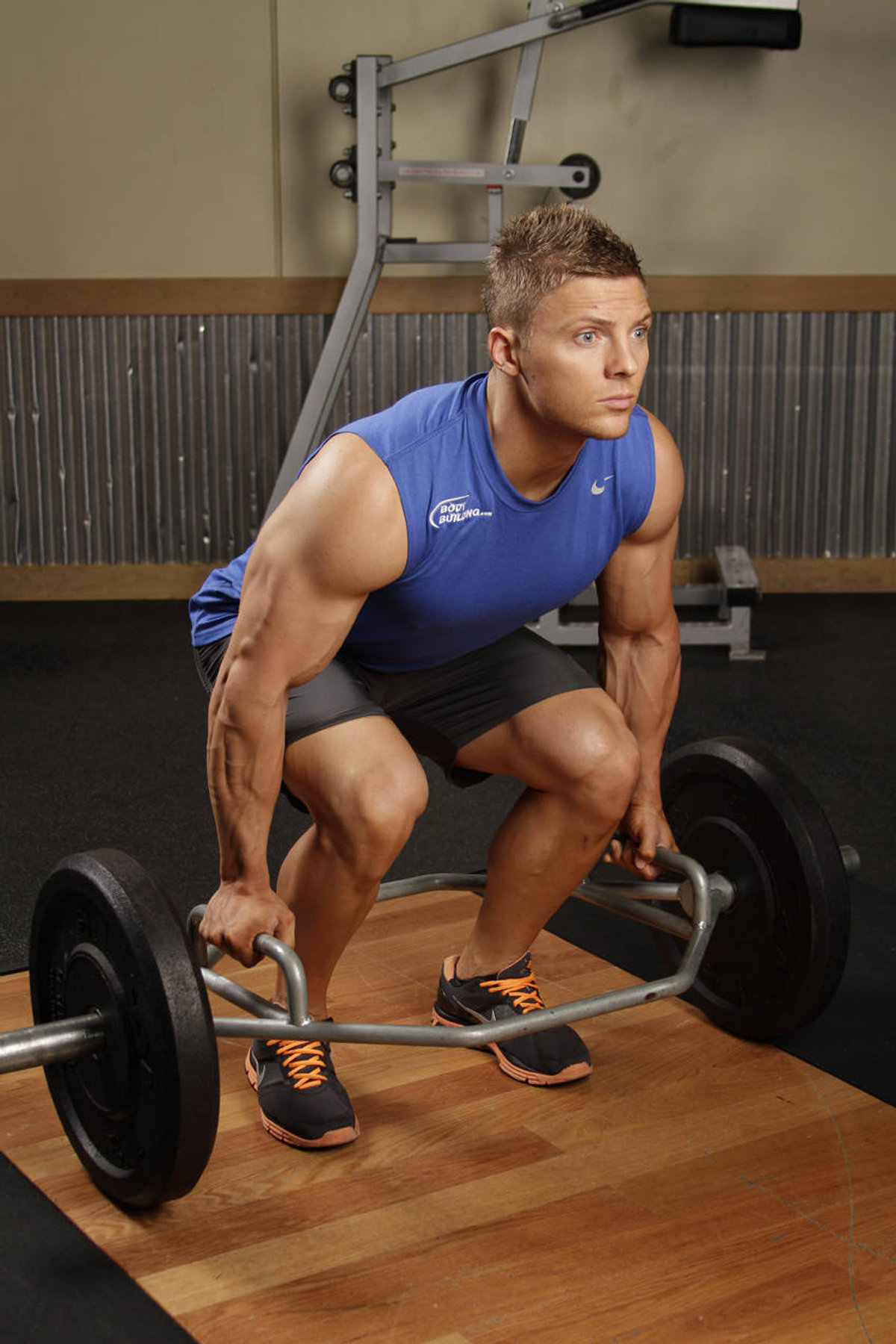
Trap Bar Deadlift
Safety Rating for 40+
Benefits for 40+
The trap bar deadlift is the safest and most effective deadlift variation for 40+. Swinton et al. (JSCR, 2011) demonstrated reduced peak spine and hip moments compared to conventional deadlifts. The neutral grip protects wrists, and the more upright body position reduces shear forces on the discs. As a full-body exercise it provides maximum osteogenic stimulus – meta-analyses show that axially loaded exercises at ≥70% 1RM significantly improve bone density at the hip and femoral neck.
Form Cues
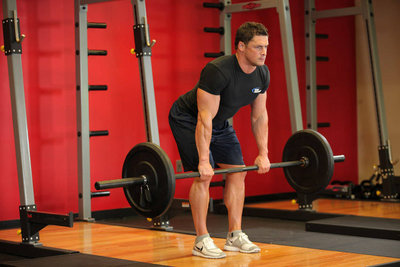
- Stand in the center of the trap bar, grip handles with neutral grip
- Chest up, back straight – drive the weight up through the legs
- Extend hips and knees simultaneously, squeeze glutes at top
Common Mistakes
- Rounding the back – even with the trap bar, a neutral spine is non-negotiable per McGill's principles
- Increasing weight too quickly – tendons need significantly longer adaptation time after 40 (48–72h recovery)
- Picking up weight too far in front of or behind center of gravity – the centered position in the trap bar is critical
- Lockout with back hyperextension – extension ends when hips are neutral, not beyond
Modifications
Beginner
Start with the elevated handles of the trap bar (less ROM, less lumbar stress). Light weight, focus on technique. 8–10 reps at RPE 6–7. Progress only with perfect technique.
For Joint Issues
For back issues: use elevated handles to limit ROM. Keep weight conservative, RPE never above 7. For persistent lumbar pain: hip thrust or leg press as safer alternative for the posterior chain. Follow McGill's spine-sparing principles – no training during acute pain.
Advanced
Low handles for increased ROM. Deficit trap bar deadlifts (standing on platform) for maximum hip extensor activation. Pause reps at the floor (2 sec hold). Heavy singles at RPE 8 maximum 1x/week.
Scientific Basis
Swinton et al. (JSCR, 2011) demonstrate reduced peak spine and hip moments versus conventional deadlifts. Neutral grip reduces wrist stress. Tier 1 exercise per research – safest deadlift variation for 40+.
Contraindications
- Acute herniated disc or acute lumbar pain – avoid all axial loading until symptom-free
- Severe spinal canal stenosis – compression from axial loading can worsen symptoms
- Uncontrolled hypertension – the Valsalva maneuver during heavy lifts significantly increases blood pressure
- Severe hip arthritis with limited flexion – the starting position requires adequate hip mobility
- Acute tendon irritation in the lower back or hamstrings – observe at least 72h recovery
Related Exercises
Related Guides