
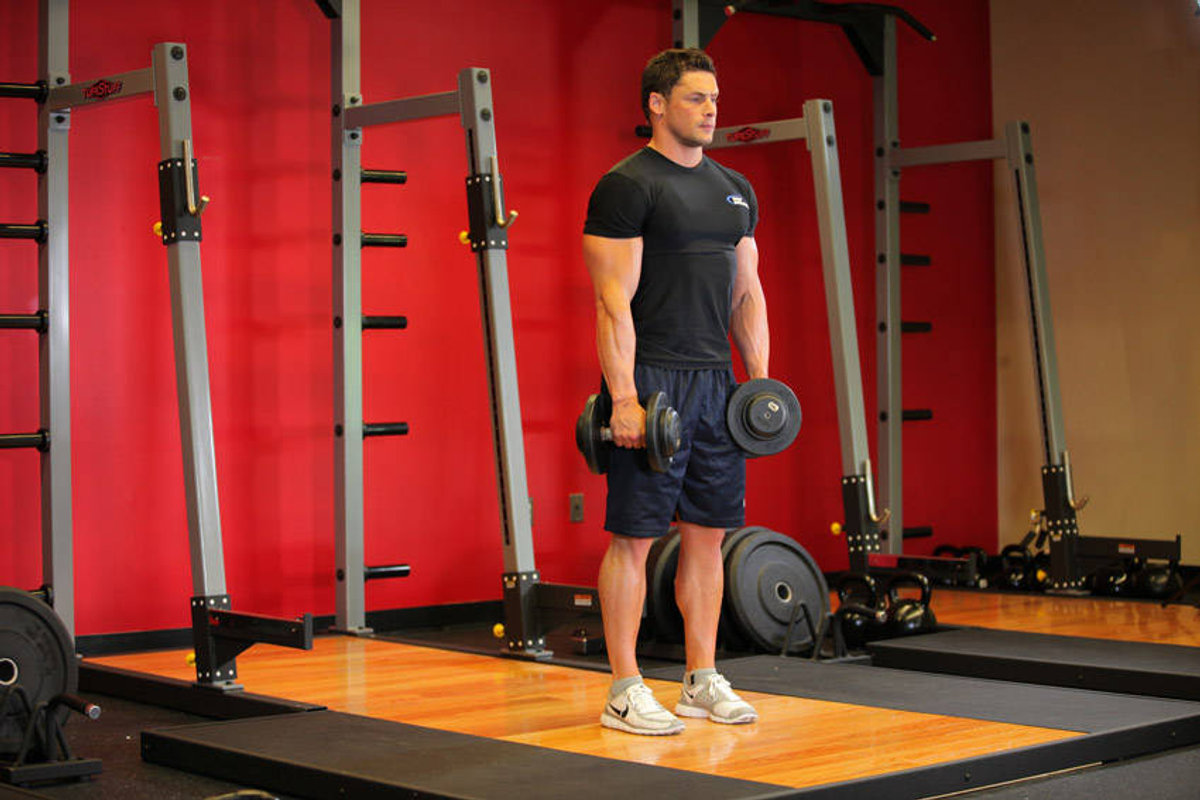
Stiff-Legged Dumbbell Deadlift
Safety Rating for 40+
Benefits for 40+
The stiff-legged dumbbell deadlift trains the hamstrings in a stretched position – Kassiano & Schoenfeld (2023) showed that training at stretched muscle lengths promotes superior hypertrophy. The dumbbell variation offers a lower entry barrier than the barbell version and requires less lumbar stability. After 40, strong hamstrings are essential for knee stability and anterior cruciate ligament protection.
Form Cues
- Dumbbells in front of thighs, legs nearly straight (slight knee bend)
- Hip hinge with straight back – guide dumbbells close to legs
- Feel stretch in hamstrings – only as deep as pain-free range allows
Common Mistakes
- Back rounds – the most common and dangerous problem, especially for over-40s with degenerative spinal changes
- Lowering too deep beyond hamstring flexibility, forcing a rounded back
- Knees completely locked instead of slightly bent – unnecessary stress on posterior knee ligaments
- Weights guided far from the body, lengthening the lever arm on the lumbar spine
Modifications
Beginner
Start with very light dumbbells and let hamstring stretch determine depth – not a target on the floor. Use a mirror or video feedback for back position.
For Joint Issues
For back issues: limit range of motion to pain-free range, keep weights close to the body. For knee issues: maintain slight knee bend. Alternative for back problems: cable pull-through as a more back-friendly hinge exercise.
Advanced
Single-leg stiff-legged deadlift for maximum hamstring isolation and balance training. Tempo variation: 4-second eccentric for increased tendon loading.
Scientific Basis
Dumbbell variation of the stiff-legged deadlift with lower entry barrier than the barbell version. Emphasizes hamstrings in the stretched position – Kassiano & Schoenfeld (2023): training at stretched lengths promotes superior hypertrophy.
Contraindications
- Acute herniated disc or severe spinal stenosis
- Acute sciatica or radiating back pain
- Inability to maintain a neutral back even with light weight
Related Exercises
Related Guides