
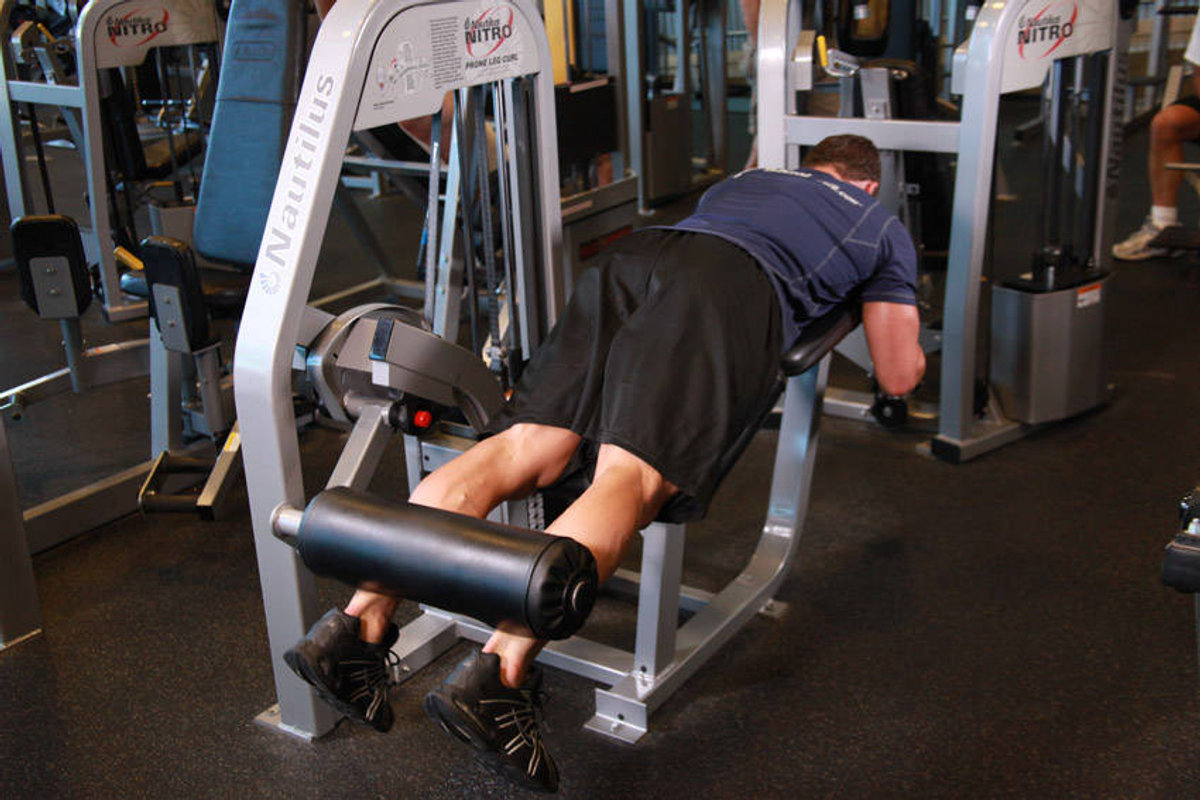
Lying Leg Curl
Safety Rating for 40+
Benefits for 40+
The lying leg curl offers the highest SFR of all hamstring exercises: no systemic fatigue, safe to train to failure, and ideal for volume accumulation. For over-40 trainees with reduced recovery capacity, this is particularly valuable. Hamstring isolation in the hip-flexed position emphasizes the pre-stretch of the muscles – Kassiano & Schoenfeld (2023) showed superior hypertrophy from training at stretched muscle lengths.
Form Cues
- Press hips firmly into pad – they must not lift off
- Position pad just above the heel
- Curl and extend under control – eccentric phase 2–3 seconds
Common Mistakes
- Hips lift off the pad – reduces hamstring stretch and compensates through the lower back
- Pad incorrectly positioned (too high on shin) – reduces lever arm
- Uncontrolled lowering in the eccentric phase – wastes the most valuable part of the movement
- Too heavy weight with momentum instead of controlled muscle work
Modifications
Beginner
Start with light weight and full range of motion. Focus on hip position – hips stay on the pad.
For Joint Issues
For knee issues: limit range of motion to pain-free range, check pad position. For back issues: hips must stay on the pad – if the pelvis tips, reduce weight.
Advanced
Train single-leg for asymmetry correction. Eccentrically emphasized variation: lift bilaterally, lower unilaterally (3–5 sec). Rest-pause sets for maximum volume accumulation.
Scientific Basis
Pure hamstring isolation in hip-flexed position (pre-stretch of hamstrings). Highest SFR of all hamstring exercises – no systemic fatigue, safe to train to failure (RPE 8–10). Ideal for volume accumulation.
Contraindications
- Acute hamstring strain or tear – wait for complete healing
- Acute popliteal (back of knee) complaints
- Acute back problems where the prone position causes pain
Related Exercises
Related Guides