
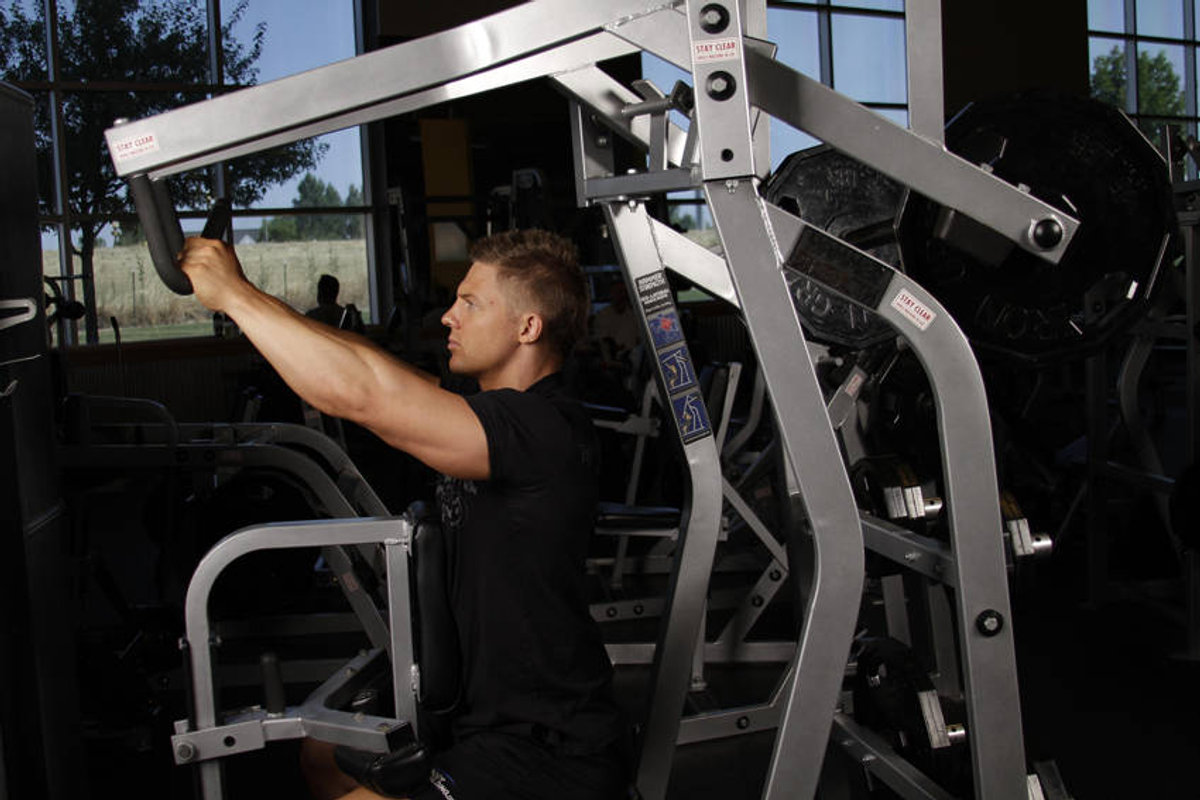
Machine High Row
Safety Rating for 40+
Benefits for 40+
The machine-supported row offers the highest stimulus-to-fatigue ratio of all rowing variations. The chest pad eliminates all lumbar spine loading, making it the safest choice for 40+ with back problems or disc degeneration. Fisher et al. (2024) show across 17 studies that machine-based training offers significantly lower injury risk in older adults – with comparable hypertrophy results to free weight variations.
Form Cues
- Press chest firmly into pad – this stabilizes the lumbar spine
- Pull handles to chest, squeeze shoulder blades together
- Return under control – allow full stretch at the turnaround point
Common Mistakes
- Lifting chest off the pad and using momentum – eliminates lumbar protection and reduces muscle activation
- Pulling only with arms without scapular activation – shifts stimulus from back to biceps
- Returning too quickly – wastes eccentric training stimulus important for 40+ tendon health
- Not fully returning handles to starting position – shortens ROM and stretch stimulus
Modifications
Beginner
Light weight, full range of motion. Focus on consciously squeezing shoulder blades at the contracted point. 12–15 reps at RPE 6–7.
For Joint Issues
For back issues: this exercise is already the most back-friendly rowing variation. Adjust pad height for the most neutral lumbar position. For shoulder problems: choose a narrower grip and limit range of motion to pain-free range.
Advanced
Drop sets on the machine for maximum volume with minimal technique degradation. Unilateral execution (one side per set) for increased ROM. Tempo 2-1-3 (2 sec pull, 1 sec hold, 3 sec eccentric).
Scientific Basis
The research recommends machine row as especially shoulder-safe. The chest pad completely eliminates lumbar spine loading – a decisive advantage for 40+ with back issues. Highest SFR of all rowing variations.
Contraindications
- Acute rib injuries aggravated by the chest pad
- Recent shoulder injuries that cannot be moved against resistance
- Severe respiratory conditions where the prone position restricts breathing
Related Exercises
Related Guides