
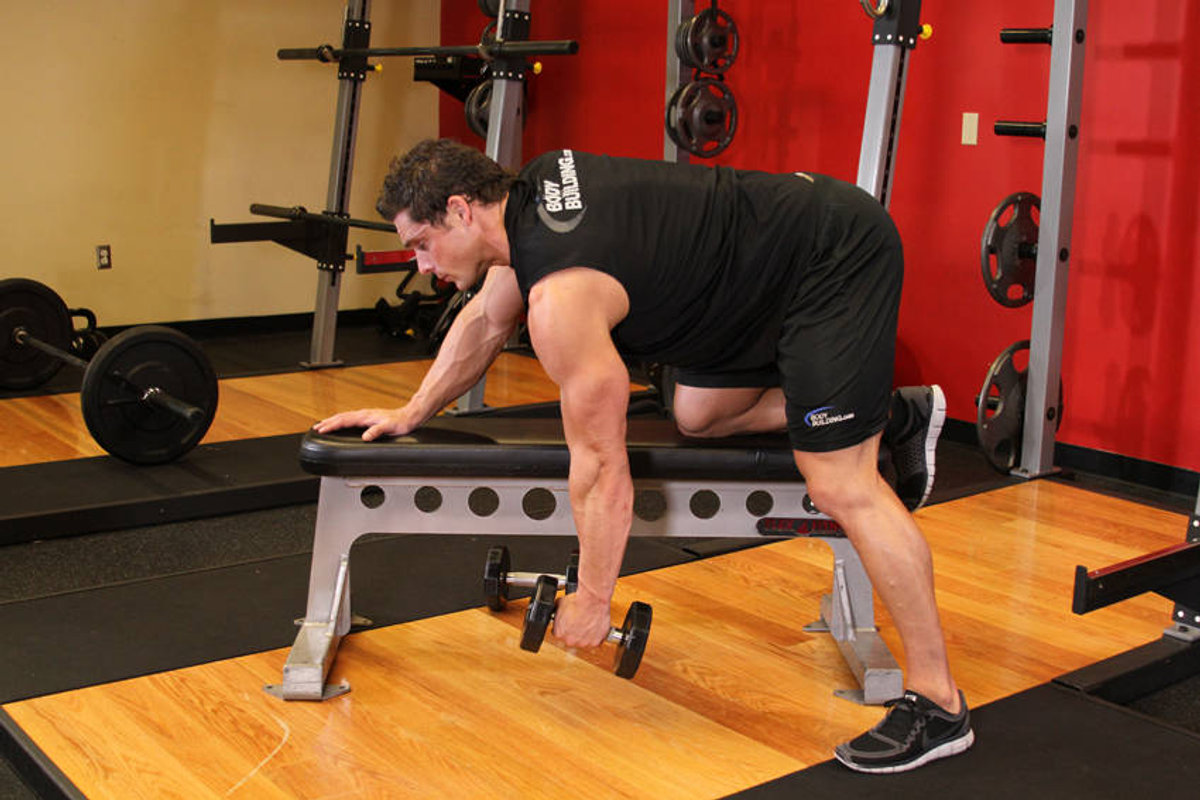
One-Arm Dumbbell Row
Safety Rating for 40+
Benefits for 40+
The one-arm dumbbell row is one of the most back-friendly rowing variations for 40+, as the supported position completely unloads the lumbar spine. Unilateral training reveals and corrects the muscular side imbalances common after 40 – Mann et al. (2014) show that 72% of training adaptations are influenced by genetic variability, making individual corrections essential. The free movement path allows joint-specific adaptation.
Form Cues
- Support one hand and knee on bench – keep back flat
- Pull dumbbell toward hip bone, not the ribcage
- Consciously squeeze the shoulder blade at the top
Common Mistakes
- Torso rotation – rotates the spine under load increasing disc injury risk
- Too heavy weight using hip momentum – eliminates training stimulus in target muscle
- Pulling dumbbell to ribcage instead of hip – shifts activation from lat to biceps
- Not properly locking the support arm – leads to unstable base and back compensation
Modifications
Beginner
Start with a light dumbbell focusing on scapular retraction. Keep elbow close to the body. 10–12 reps per side at RPE 6–7.
For Joint Issues
For back issues: use a higher bench or support on an incline bench to optimize lumbar position. Choose weight that doesn't require torso rotation. For wrist pain: maintain neutral grip and consider using lifting straps.
Advanced
Kroc rows: heavier weight, 15–20 reps with slight momentum for maximum lat fatigue. Meadows row (barbell in landmine) for altered force vector. Pause reps at the contracted point.
Scientific Basis
Unilateral training reveals and corrects muscular imbalances. The supported position completely unloads the lumbar spine – ideal for 40+ with back issues. High SFR with free movement path.
Contraindications
- Acute disc problems aggravated by the bent-over position
- Severe wrist arthritis making gripping painful
- Unstable shoulder on the working side
- Stop immediately if lower back pain exceeds 3/10 despite the supported position
Related Exercises
Related Guides