
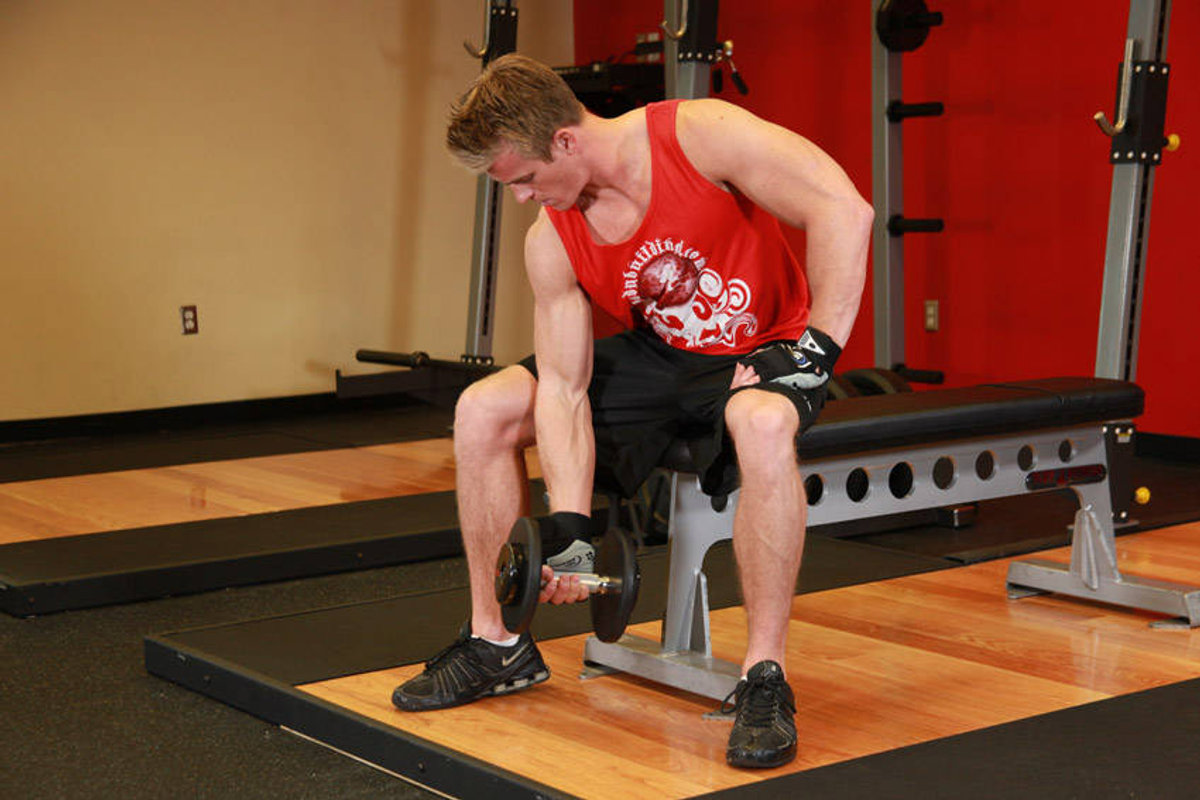
Concentration Curl
Safety Rating for 40+
Benefits for 40+
The seated position with elbow braced against the thigh eliminates all compensation from torso or shoulders – especially valuable for 40+ where compensation patterns more frequently lead to injuries. The unilateral execution reveals side imbalances that often worsen with age due to one-sided daily activities or old injuries. As a finisher exercise with moderate weights, it's minimally stressful on the joints.
Form Cues
- Seated: brace elbow against the inner thigh
- Curl slowly – consciously focus on the muscle contraction
- Hold peak contraction at top 1–2 sec, lower under control
Common Mistakes
- Torso rotating to assist – eliminates the isolation effect and stresses the lower back
- Elbow slipping off the thigh – loses the brace and allows momentum
- Wrist bending during flexion – increased risk of wrist flexor overuse in 40+
- Too heavy weight – concentration curls are technique and mind-muscle exercises, not a max-strength tool
Modifications
Beginner
Very light weight (2–5 kg), focus on mind-muscle connection. 15 reps per side with deliberate 2-second contraction at top.
For Joint Issues
For elbow issues: reduce weight further, limit ROM to pain-free range. Alternatively: isometric holds in the mid-ROM position.
Advanced
Eccentric-emphasized execution: 2 seconds up, 5 seconds controlled lowering. Or as a finisher after heavy compound sets.
Scientific Basis
ACE study (2014) shows highest biceps activation of all curl variations. The fixed elbow position completely eliminates momentum. Unilateral execution reveals side imbalances. Perfect finisher exercise at moderate weights.
Contraindications
- Acute medial epicondylitis – the supinated curl movement directly stresses the medial tendons
- Acute biceps tendon inflammation – even moderate weights can worsen the inflammation
- Severe wrist arthritis – the grip load in the seated position is difficult to compensate
Related Exercises
Related Guide