
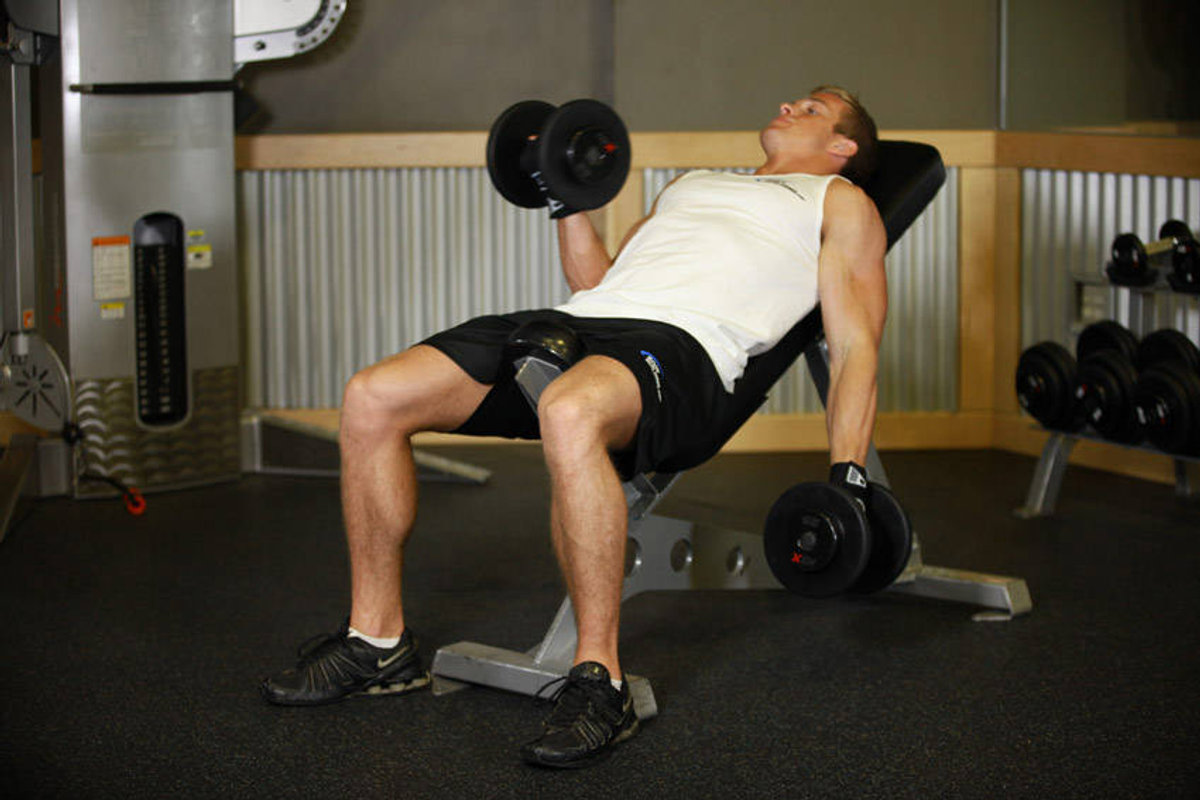
Incline Dumbbell Curl
Safety Rating for 40+
Benefits for 40+
Kassiano & Schoenfeld (2023) show that training at stretched muscle lengths delivers superior hypertrophy results – particularly valuable in combating the anabolic resistance that begins in the fifth decade of life (Burd et al., 2013). The incline position eliminates all momentum and enforces clean technique, minimizing injury risk for aging tendons and ligaments. The emphasized eccentric phase also promotes collagen synthesis in tendon tissue.
Form Cues
- Set incline bench to approximately 45°, back fully reclined
- Arms hang vertically – biceps in maximum stretch
- Curl slowly without momentum – eccentric phase 3 seconds
Common Mistakes
- Bench set too steep (above 60°) – reduces the stretch effect and thus the hypertrophy advantage
- Swinging from the shoulders – especially dangerous for the rotator cuff in 40+
- Too fast eccentric phase – wastes the main advantage of the exercise and increases tendon risk
- Too heavy weights – in the stretched position the biceps is at a mechanical disadvantage, ego lifting leads to compensation
Modifications
Beginner
Set bench to 55–60° instead of 45° for less shoulder stretch. Very light weights, focus on the stretch at the bottom.
For Joint Issues
For shoulder issues (impingement): increase bench angle to 60°, limit ROM at the bottom – don't force passive stretch into shoulder extension. Alternatively switch to cable curl.
Advanced
3-second eccentric plus 2-second pause in the stretched position. Alternatively: alternating single-arm for maximum focus on the target muscle.
Scientific Basis
Kassiano & Schoenfeld (2023): training at stretched muscle lengths promotes superior hypertrophy. The incline bench places biceps in maximum stretch through shoulder extension. Caution shoulder: prior impingement may be irritated by the extension.
Contraindications
- Acute shoulder impingement – shoulder extension in the incline position worsens the impingement
- Biceps tendon tendinopathy – maximum stretch stresses the long biceps tendon at the shoulder attachment
- Shoulder joint instability (habitual dislocation) – the extreme arm position can provoke subluxation
Related Exercises
Related Guides