
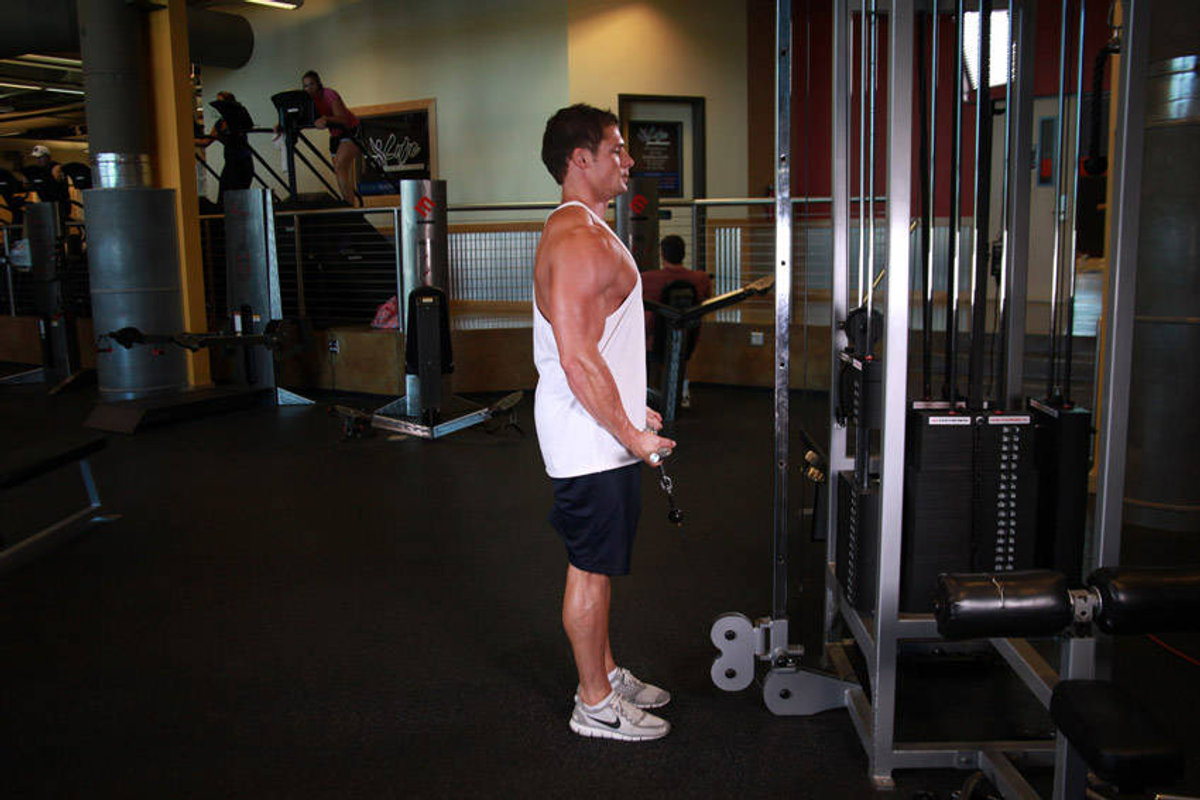
Standing Cable Bicep Curl
Safety Rating for 40+
Benefits for 40+
The constant cable resistance protects the elbow joints by eliminating jerky load peaks that occur with free weights – especially relevant after 40 when tendons lose elasticity and become more susceptible to epicondylitis. This isolation exercise enables targeted muscle building against age-related sarcopenia with minimal systemic stress, respecting the extended recovery times after 40. Safe to train to failure, which facilitates RPE calibration.
Form Cues
- Keep elbows fixed at your sides – only forearms move
- Curl and extend under control – no momentum from the torso
- Full extension at bottom, maximum contraction at top – hold 1 sec
Common Mistakes
- Swinging from hips or back – increased risk of lower back irritation for 40+
- Elbows drifting forward – shifts load to anterior deltoid and unloads the biceps
- Too fast eccentric phase – controlled eccentrics are crucial for tendon adaptation after 40
- Wrists bending backward – increases stress on wrist flexors and can aggravate epicondylitis symptoms
Modifications
Beginner
Perform single-arm to focus on correct technique. Light weight, 15–20 reps to learn the movement pattern.
For Joint Issues
For elbow issues (epicondylitis): significantly reduce weight, use rope attachment instead of bar for neutral grip. Respect pain-free ROM – don't force full extension.
Advanced
Drop sets on cable (quick weight change via pin adjustment). 21s method: 7 reps lower half, 7 reps upper half, 7 reps full ROM.
Scientific Basis
Constant cable resistance throughout full ROM – unlike dumbbells which lose tension at top and bottom. High SFR, safe to train to failure (RPE 8–10). Isolation exercises per research ideal for volume accumulation.
Contraindications
- Acute medial epicondylitis (golfer's elbow) – underhand grip stresses the medial tendons
- Acute biceps tendon inflammation – wait for complete healing
- Significant wrist pain during supination – switch to neutral grip (rope)
Related Exercises
Related Guides