
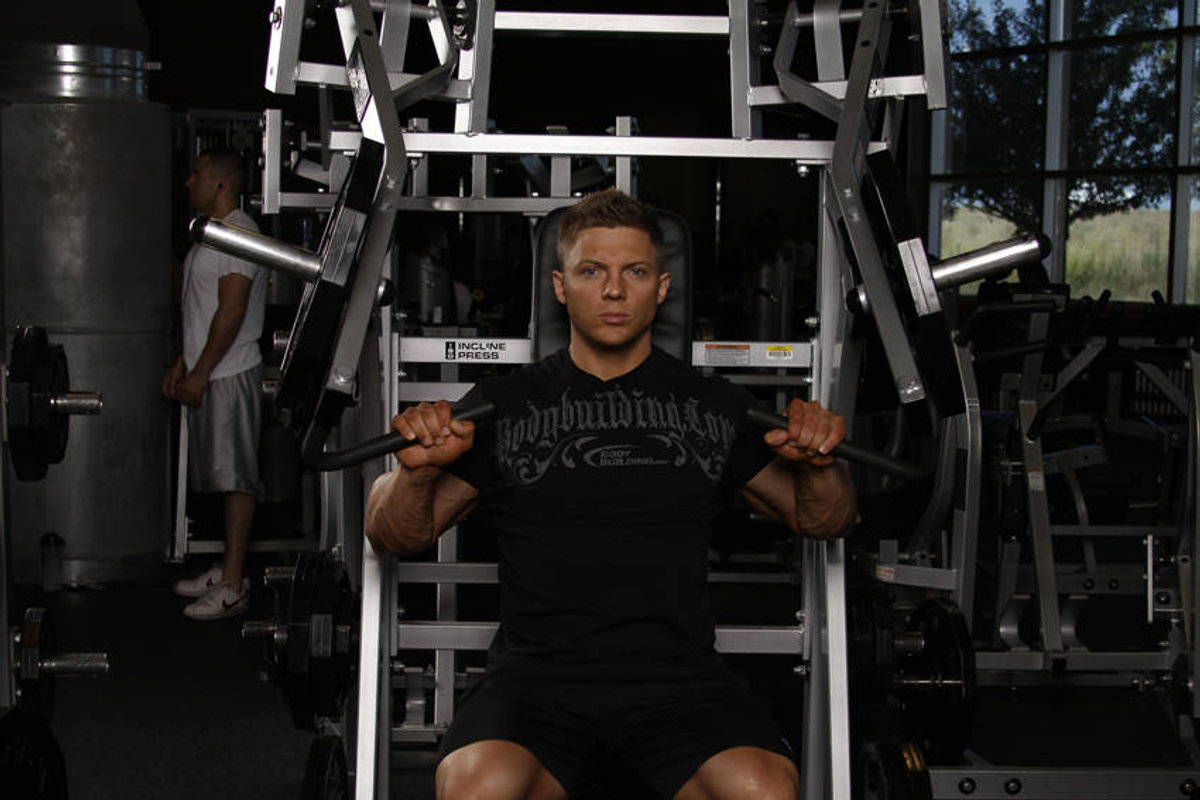
Machine Incline Chest Press
Safety Rating for 40+
Benefits for 40+
The upper chest commonly loses volume and strength first after 40 – the machine incline press counteracts this directly. The guided path eliminates stabilization demands, protecting tendons and ligaments that lose elasticity from the fifth decade of life. However, the incline position requires increased shoulder awareness (rated: Caution) as the overhead component can stress the subacromial space. Especially valuable as a controlled re-entry after training breaks, since tendons need 4–6 weeks longer than muscles to adapt to loading.
Form Cues
- Press upper back and shoulder blades firmly into the pad
- Controlled movement — elbows at roughly 45° from torso
- Full extension without hyperextending elbows
Common Mistakes
- Shrugging shoulders instead of depressing and retracting scapulae – increases trap involvement and reduces chest tension
- Bench set too steep (if adjustable) – above 45° it becomes primarily a shoulder exercise
- Pressing arms explosively to lockout – risks elbow tendon overload in 40+ trainees
- Increasing weight too fast – conservative progression (2.5% per week) protects tendons that become more vulnerable after 40
Modifications
Beginner
Start with minimal weight focusing on the connection between scapular retraction and chest contraction. 2–3 sets of 12–15 reps at RPE 5–6 in the first weeks.
For Joint Issues
For shoulder impingement: shorten range of motion – lower only to 90° elbow flexion. If the machine offers different grip positions, choose the most neutral (narrowest) grip.
Advanced
Single-arm execution for correcting strength asymmetries. 1.5 reps (bottom – halfway up – bottom – full lockout) for extended time under tension.
Scientific Basis
Guided incline path emphasizes upper chest with a consistent resistance profile. Ideal as an entry point for 40+ adults since no stabilization demand exists and the weight cannot fall.
Contraindications
- Acute shoulder impingement with pain above 3/10 during pressing
- Active inflammation of the biceps tendon (long head)
- Acute rib injury or sternum complaints
- Uncontrolled hypertension at high intensities
Related Exercises


Related Guides