
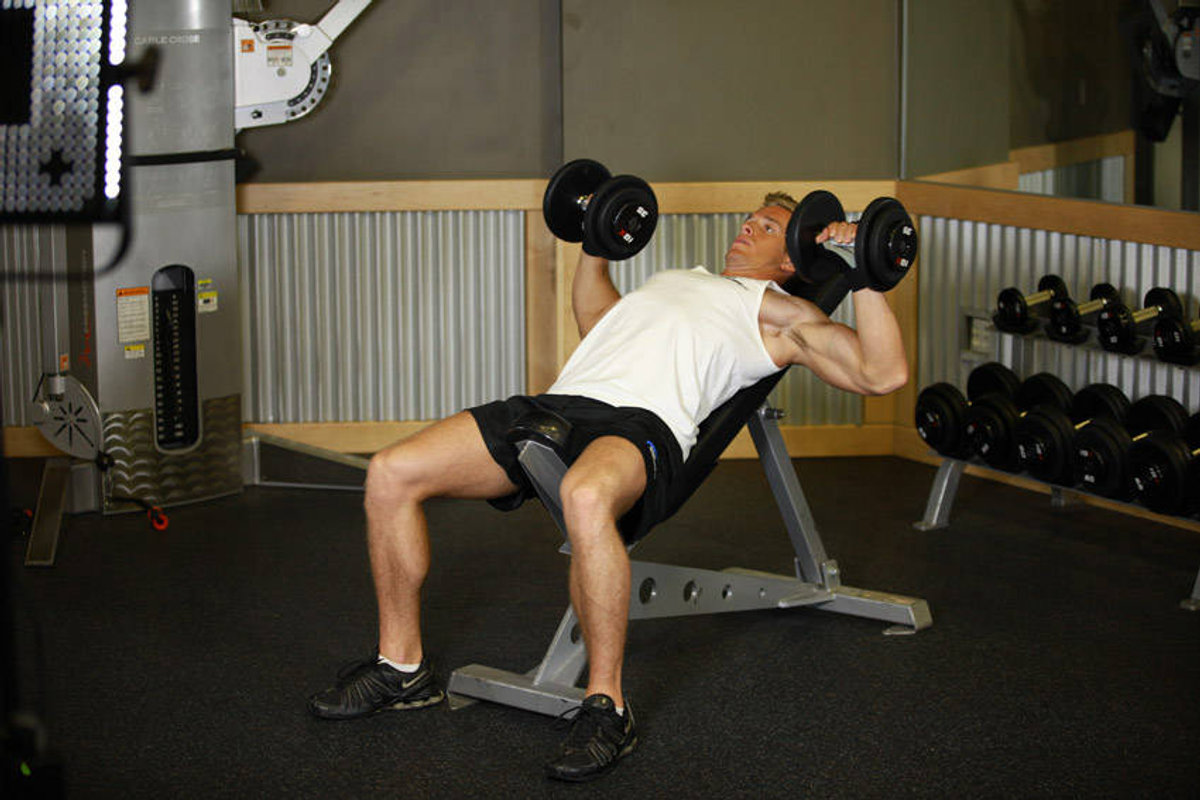
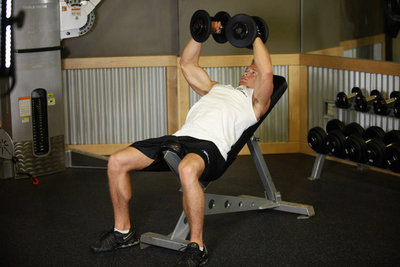
Incline Dumbbell Press
Safety Rating for 40+
Benefits for 40+
The upper chest is rarely engaged in daily life and atrophies especially quickly after 40 – targeted incline pressing directly counteracts this. Dumbbells allow individual adaptation to shoulder geometry, essential with age-related shoulder joint stiffening. Unilateral loading corrects side-to-side differences and promotes neuromuscular coordination, which can decline after 40 due to hormonal changes (approximately 1–2% testosterone decline per year).
Form Cues
- Set bench to approximately 30–45° — not too steep
- Lower dumbbells to upper chest level
- Controlled tempo: 2 sec lowering, 1 sec pressing
Common Mistakes
- Setting bench too steep (above 45°) – becomes a shoulder exercise and significantly increases impingement risk in 40+ trainees
- Lowering dumbbells too deep – shoulder stretch at incline is already more intense than on flat bench
- Feet not firmly planted on floor – lack of stability leads to compensatory lower back movements
- Uneven depth left/right – pay attention to symmetrical range of motion
Modifications
Beginner
Set bench to only 30° (instead of 45°) – reduces shoulder stress. Start with light weights, 3 sets of 10–12 reps at RPE 6–7.
For Joint Issues
For shoulder issues: choose a shallower angle (20–30°), use neutral grip, or switch to the machine variation. For wrist issues: use neutral-grip dumbbells or wrist wraps.
Advanced
Eccentric tempo of 4–5 seconds for enhanced tendon adaptation. Drop sets as an intensity technique – particularly practical with dumbbells due to quick weight changes.
Scientific Basis
Incline pressing emphasizes the upper portion of pectoralis major. Dumbbells provide free movement path and unilateral loading. Moderate shoulder consideration due to the overhead component — keep angle below 45°.
Contraindications
- Acute shoulder impingement with pain when raising arm above 90°
- Shoulder joint instability (subluxation tendency)
- Active inflammation of the long head biceps tendon
- Significant wrist pain when gripping despite wrist wraps
Related Exercises
Related Guides