
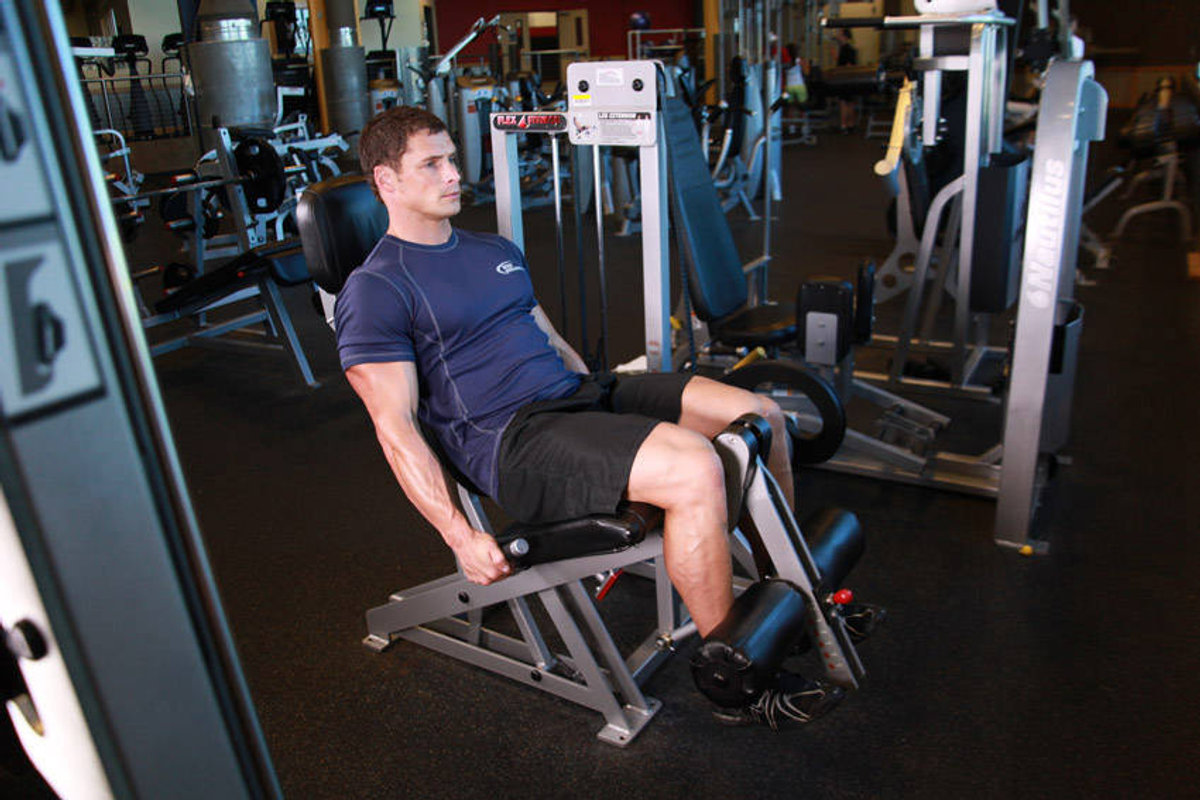
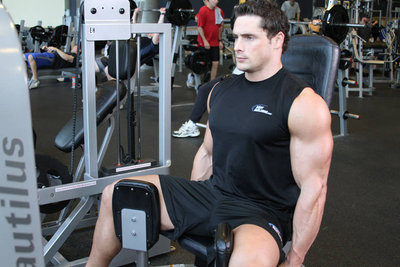
Leg Extension
Safety Rating for 40+
Benefits for 40+
Leg extensions offer excellent SFR for quadriceps isolation when performed with controlled execution and moderate weights – despite their controversial reputation. The NSCA recommends avoiding ballistic open-chain extension with knee OA, but controlled execution is considered safe. Studies even show that persons with severe knee OA (awaiting joint replacement) can participate in high-intensity RT without worsening pain – while reducing pain by 43%. For over-40 trainees without acute knee problems, this exercise is a valuable tool for isolated quadriceps hypertrophy.
Form Cues
- Align machine pivot to knee center
- Position pad at lower shin, not on top of foot
- Moderate weights, controlled tempo – limit ROM if knee pain occurs
Common Mistakes
- Moving heavy weight with momentum (ballistic) – exactly what the NSCA identifies as risky for knee problems
- Machine pivot not aligned to knee center – creates non-physiological shear forces
- Jerky acceleration at the bottom instead of controlled start
- Forcing full range of motion despite knee pain – ROM restriction is legitimate and sensible
Modifications
Beginner
Start with light weight and slow tempo (3/1/3). Initially limit ROM to the upper 60° (less knee shear) and gradually extend.
For Joint Issues
For knee OA: moderate weights, slow tempo, limit ROM to pain-free range (often 90°–45° flexion). For patellofemoral pain: the upper 30° of ROM may be pain-free (open chain, 90°–60°). BFR training as alternative: 20–40% 1RM with blood flow restriction offers equivalent hypertrophy with significantly less joint stress.
Advanced
Train single-leg for asymmetry correction. Drop sets or rest-pause sets – safe to train to failure. Pause at the top (1–2 sec) for maximum contraction.
Scientific Basis
Research warns against 'full-arc heavy leg extensions' with knee OA. However, at moderate weights with controlled tempo, leg extensions offer excellent SFR for quadriceps isolation. NSCA: avoid ballistic open-chain extension with knee OA – controlled execution is safe.
Contraindications
- Acute knee joint inflammation or effusion
- Recent ACL surgery (follow physician's rehab protocol – open chain often cleared late)
- Severe knee OA with pain during loading despite ROM limitation and light weight
- Acute patellar tendon irritation
Related Exercises
Related Guides