
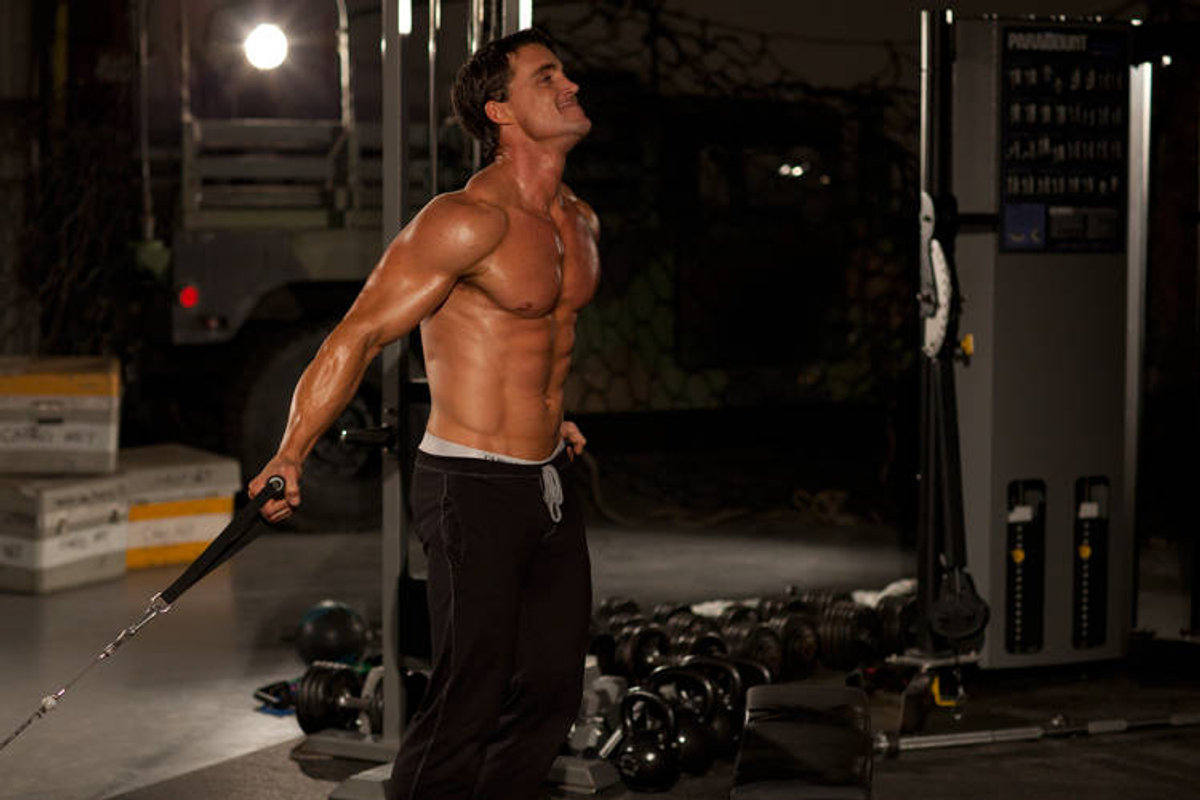
Low Cable Crossover
Safety Rating for 40+
Benefits for 40+
Targeted activation of the upper chest, which commonly loses volume first after 40 and is essential for upright, healthy posture. The upward cable pull stresses the shoulder at a more joint-friendly angle than incline weight exercises. The low systemic fatigue allows additional upper chest volume without overwhelming the limited recovery capacity after 40.
Form Cues
- Set cables low, upright stance with slight forward lean
- Bring arms together in a wide arc upward and forward
- Hold tension briefly at the top — squeeze
Common Mistakes
- Arms pulled too far behind the body in start position – risks overstretching the anterior shoulder capsule in 40+ trainees
- Upward movement going too high – above chin height it becomes a shoulder exercise
- Leaning torso too far forward – removes load from the upper chest portion
- Jerking arms together instead of controlled adduction
Modifications
Beginner
Start single-arm for better control and body awareness. Light weight, focus on the squeeze contraction at the top.
For Joint Issues
For shoulder issues: set cables slightly higher (hip height instead of near floor) to reduce shoulder angle stress. Reduce range of motion – don't open arms behind the shoulder plane.
Advanced
Single-arm with rotation for additional core activation. Slow tempo (3 sec concentric, 3 sec eccentric) for maximum muscle tension.
Scientific Basis
Emphasizes upper chest through upward-directed adduction. Complements the standard crossover (high→low) for complete stimulation across all chest fiber orientations.
Contraindications
- Acute shoulder injury or inflammation
- Severe AC joint pathology
- Anterior shoulder capsule instability
- Acute back spasm preventing upright standing under load
Related Exercises
Related Guide