
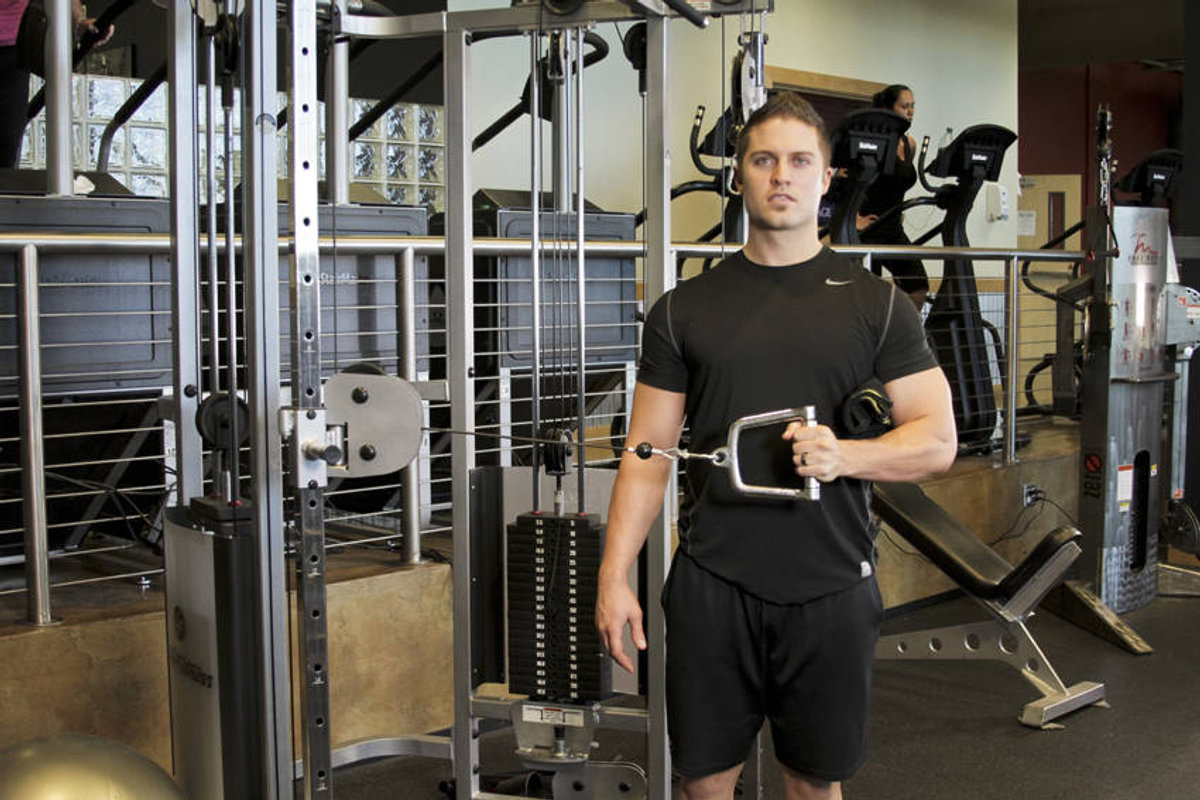
External Rotation with Cable
Safety Rating for 40+
Benefits for 40+
The cable variant of external rotation provides constant resistance throughout the full rotation range – more precisely adjustable than the band variant with its progressive resistance. For 40+ trainees, this precision enables finer load control of the rotator cuff, which responds more sensitively to overload with increasing age. The exercise is essential for preventing subacromial impingement – the most common upper body limitation after 40.
Form Cues
- Set cable at elbow height, stand sideways to the tower
- Elbow fixed at the body, rotate forearm outward
- Slow tempo: 2 sec rotate, 1 sec hold, 2 sec return
Common Mistakes
- Cable height set incorrectly – must be exactly at elbow height for correct rotation axis
- Lifting elbow away from body – changes the movement angle and loads other structures
- Execution too fast – the rotator cuff responds better to slow, controlled movements
- Weight too high and compensating with torso rotation – destroys the isolated external rotation
Modifications
Beginner
Start with lightest cable weight, focus on clean technique. Towel trick: place between elbow and body. 2 × 15 per side as standard warm-up routine.
For Joint Issues
Already one of the safest exercises overall. If pain occurs: reduce rotation range (only mid-range instead of full rotation) and set weight to minimum. Gradually expand as condition improves.
Advanced
Perform at 90° abduction (arm raised to side at shoulder height, elbow bent 90°) for more functional rotator cuff strengthening. More demanding and sport-specific.
Scientific Basis
Cable provides constant resistance during external rotation – more precisely controllable than bands with their progressive resistance. Complements the band variant for the gym setting. Same preventive value for the rotator cuff.
Contraindications
- No significant contraindications – one of the safest exercises overall
- For acute rotator cuff tear: obtain medical clearance
- For frozen shoulder: rotation range may be limited – only work within pain-free range
Related Exercises
Related Guide