
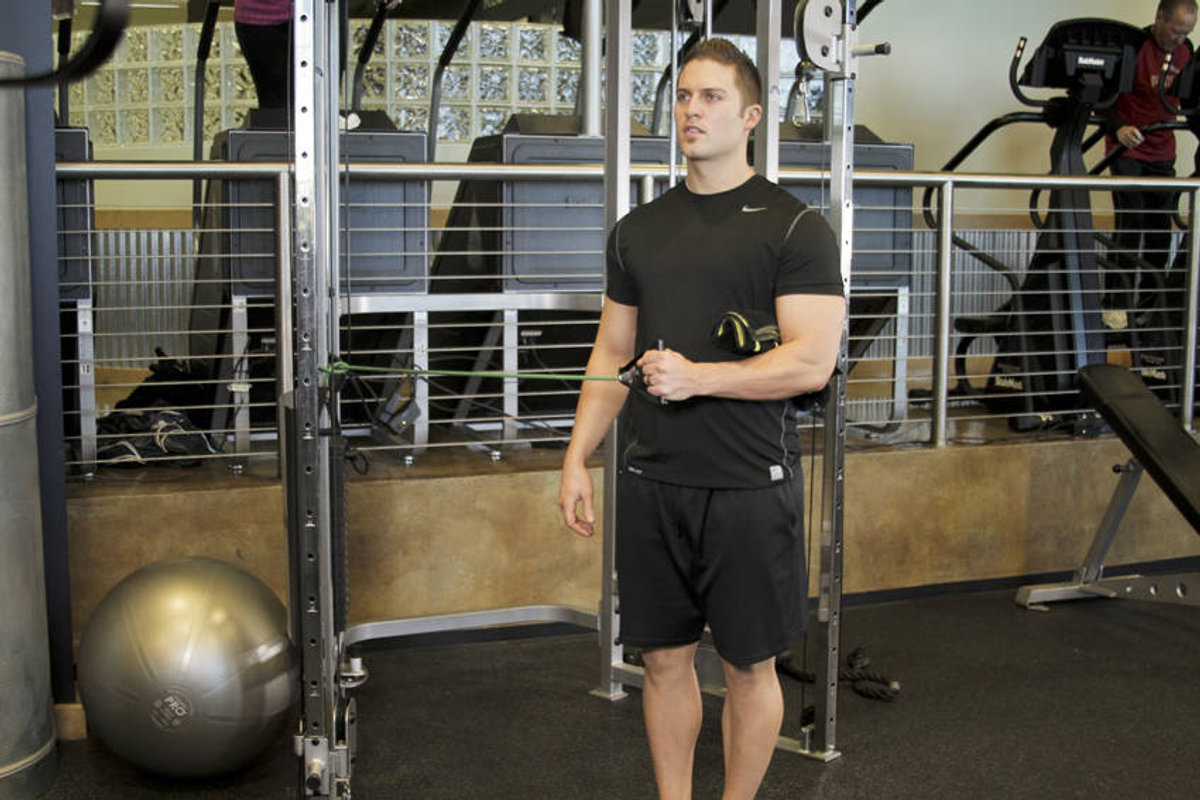
External Rotation with Band
Safety Rating for 40+
Benefits for 40+
Band external rotation specifically strengthens infraspinatus and teres minor – the primary external rotators of the rotator cuff that are particularly susceptible to degenerative changes after 40. Research explicitly lists this exercise as safe in the impingement safety matrix. As a daily prevention exercise with minimal fatigue, it can significantly reduce the risk of the most common shoulder condition after 40. The progressive band resistance naturally matches the strength curve of the external rotators.
Form Cues
- Elbow fixed at the body, forearm at 90° angle
- Slowly rotate band outward – elbow stays stable
- Return under control – no snapping of the band
Common Mistakes
- Lifting elbow away from the body – completely changes the exercise and reduces external rotation isolation
- Choosing a band too strong and compensating with the upper body – destroys the preventive purpose
- Letting band snap back instead of controlled return – the eccentric is an essential part of the training stimulus
- Bending the wrist instead of keeping it neutral – shifts rotation to the wrist
Modifications
Beginner
Start with the thinnest band. Place a folded towel between elbow and body as a tactile reminder to keep the elbow fixed.
For Joint Issues
Already the safest exercise for the rotator cuff. If pain occurs: support the elbow laterally with a towel pad and reduce rotation angle from 90° to 60°.
Advanced
Perform at 90° shoulder abduction (arm out to the side at shoulder height) for increased rotator cuff demand. Or: isometric holds at end point for 10 seconds.
Scientific Basis
Research explicitly lists band external rotation as safe in the shoulder impingement safety matrix. Strengthens infraspinatus and teres minor – the primary external rotators of the rotator cuff. Essential for 40+ as prevention and rehabilitation.
Contraindications
- No significant contraindications – explicitly listed as safe exercise
- For acute rotator cuff tear: obtain medical clearance
- For acute shoulder inflammation: keep range of motion and resistance minimal
Related Exercises
Related Guides