
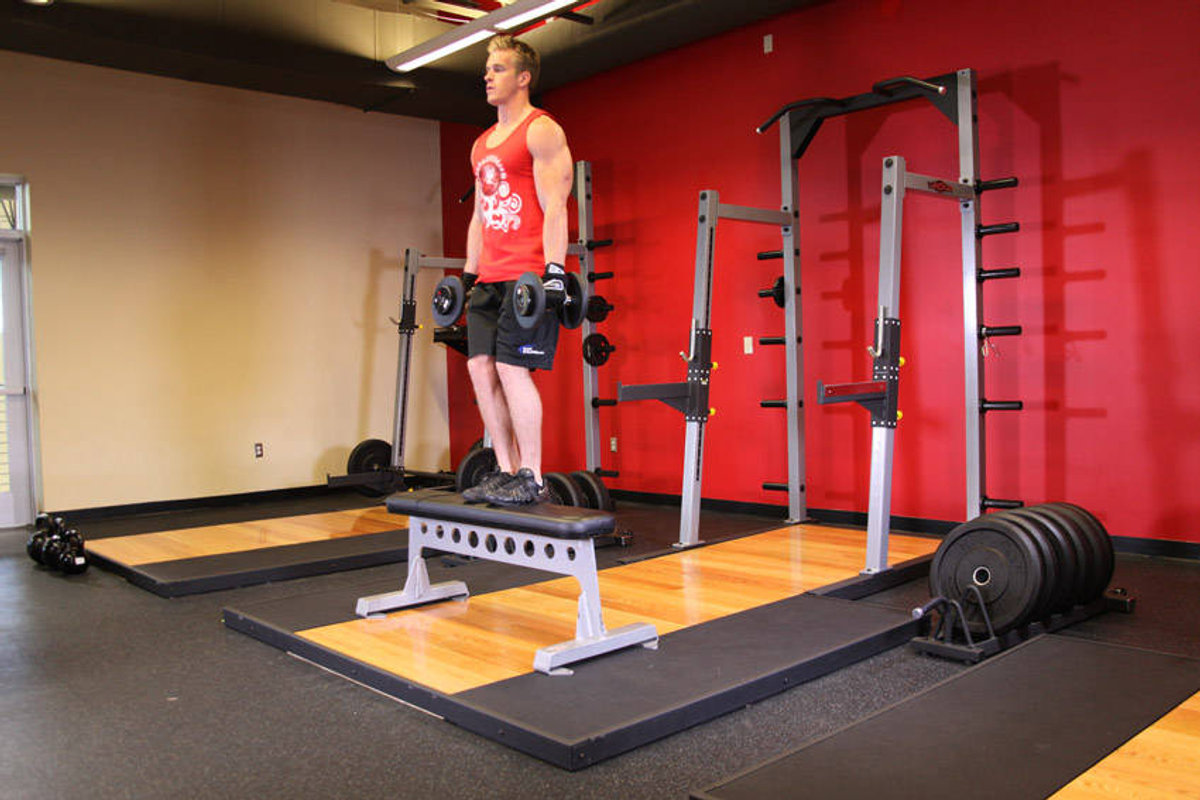
Dumbbell Step-Up
Safety Rating for 40+
Benefits for 40+
Step-ups are an osteogenically valuable exercise – axial loading under body weight has been shown to promote bone mineral density (BMD). Simultaneously, they directly replicate everyday stair climbing, maximizing functional transfer for over-40 trainees. At appropriate box height, they are knee-friendly and train balance as well as proprioception, whose maintenance after 40 is critical for fall prevention.
Form Cues
- Use stable box or bench – knee at approximately 90° in start position
- Drive up with the top leg only – don't push off with the bottom leg
- Lower under control, full balance on the working leg
Common Mistakes
- Pushing off with the lower leg instead of driving up with the top leg only – distorts the training stimulus
- Box too high – creates excessive knee flexion that can be problematic for over-40s
- Jumping down uncontrolled instead of lowering with control – loads joints through impact forces
- Torso leaning over the front leg – sign of insufficient leg strength
Modifications
Beginner
Start without weight with a low box (20–30 cm). One hand on wall for balance. Add weight only after demonstrating reliable control.
For Joint Issues
For knee issues: reduce box height so that the knee bends maximum 60–70°. Lower slowly and controlled instead of stepping down. For hip issues: adjust box height and use shorter steps.
Advanced
Increase box height for greater range of motion. Dumbbell step-ups with pause at the top (1–2 sec) for increased glute activation. Lateral step-ups for adductor involvement.
Scientific Basis
Research lists step-ups as an osteogenically valuable exercise – axial loading under body weight promotes bone mineral density (BMD). Knee-safe at appropriate box height. Functional movement pattern (stair climbing) with direct daily life transfer.
Contraindications
- Acute knee joint inflammation or recent knee surgery
- Severe balance disorders without support available – fall risk
- Acute Achilles tendon problems
Related Exercises
Related Guide