Seated Calf Raise
Safety Rating for 40+
Benefits for 40+
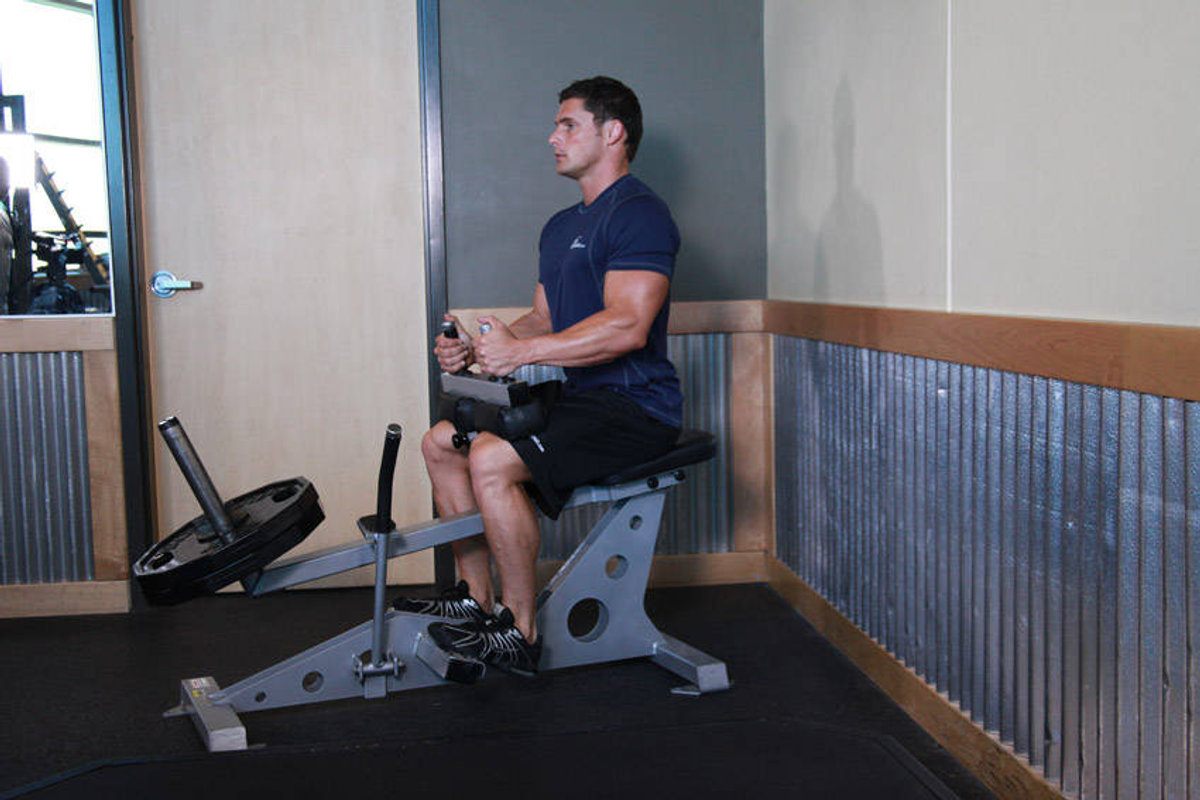
The seated calf raise specifically isolates the soleus – a muscle less targeted in standing variations but essential for endurance performance in walking and standing. The seated position is particularly valuable for over-40 trainees with shoulder or back problems that make standing calf raises on the machine painful. The pause at the deepest point promotes Achilles tendon adaptation.
Form Cues
- Thigh pad firmly in place, balls of feet on edge
- Raise and lower under control – full ROM in both directions
- Hold 1 sec stretch at bottom for tendon adaptation
Common Mistakes
- Incomplete range of motion – especially missing stretch at the bottom
- Bouncing and momentum instead of controlled movement
- Too heavy weight at the expense of ROM
- Thigh pad not tight enough
Modifications
Beginner
Start with light weight and full range of motion. Focus on the stretch phase at the bottom (hold 1–2 seconds).
For Joint Issues
For Achilles tendon issues: light weight, slow tempo, especially in the eccentric phase. For knee issues: this exercise is generally knee-friendly as the knee stays in a fixed position.
Advanced
High volume (4 × 15–20 reps) with pause at the bottom. Drop sets for maximum metabolic stress. Single-leg for asymmetry correction.
Scientific Basis
Seated position bends the knee and shortens the gastrocnemius – this variation specifically isolates the soleus. For complete calf development, both variations (standing + seated) must be combined.
Contraindications
- Acute Achilles tendon rupture or partial tear
- Acute severe plantar fasciitis
- Acute popliteal complaints (rare, but possible from pad pressure)
Related Exercises
Related Guides