
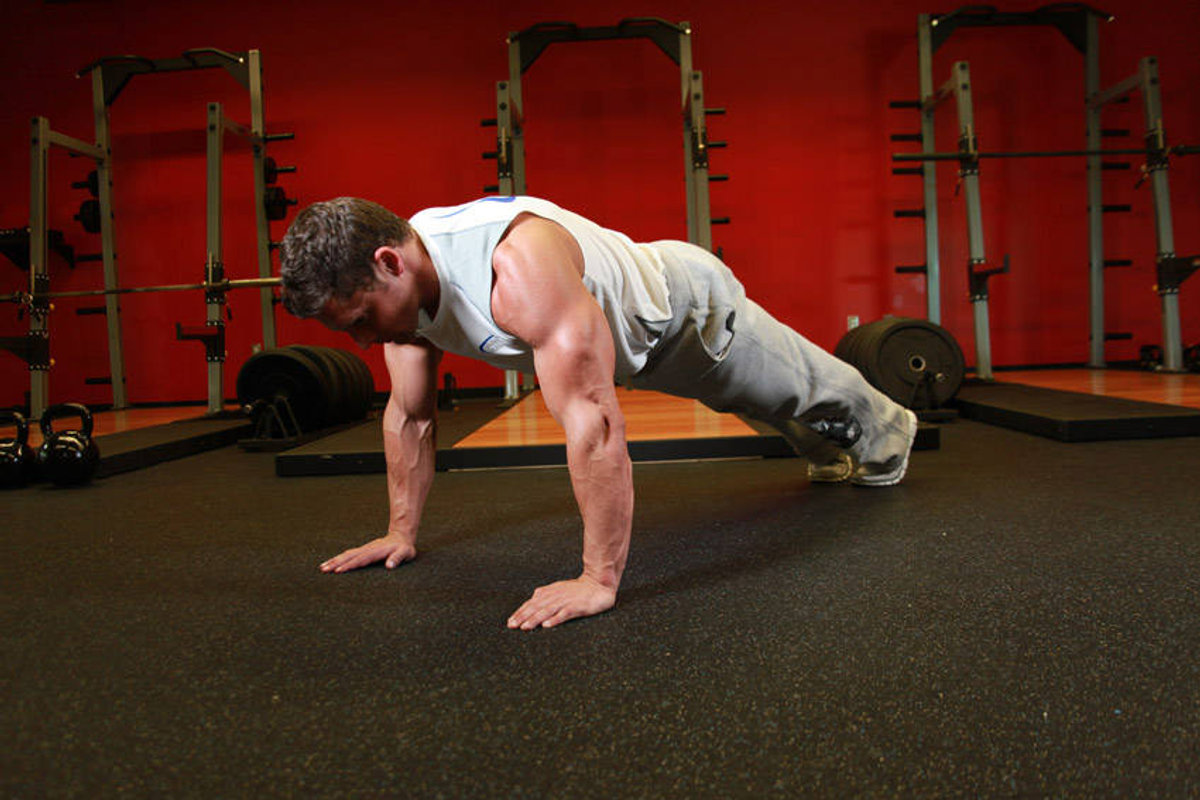
Push-Ups
Safety Rating for 40+
Benefits for 40+
Push-ups simultaneously train chest, shoulders, triceps, and core stability – a functional movement pattern that directly improves daily push-up and bracing movements. The exercise is self-limiting through body weight, naturally preventing overload. However, shoulder is rated Caution as full body weight in the bottom position can stress the anterior shoulder capsule – especially in 40+ trainees with pre-existing shoulder issues. McGill's research shows the isometric core engagement during push-ups stabilizes the spine – a key protective factor against age-related disc degeneration.
Form Cues
- Body forms a straight line from head to heels
- Hands slightly wider than shoulder-width, fingers pointing forward
- Lower chest to just above the floor — elbows at roughly 45°
Common Mistakes
- Hips sagging – loads the lower back and reduces chest activation; especially risky for 40+ trainees with pre-existing disc issues
- Flaring elbows too wide (above 60°) – significantly increases shoulder stress and promotes impingement
- Not warming up wrists – after 40, stiffer wrists need specific mobilization before push-ups
- Reps too fast – controlled tempo (especially eccentric) maximizes training stimulus and protects tendons
Modifications
Beginner
Start with incline push-ups (hands on bench or wall) and gradually decrease the angle. Knee push-ups as alternative, though incline variations are preferred.
For Joint Issues
For wrist issues: use push-up handles (neutral hand position). For shoulder issues: limit range of motion – lower only to 90° elbow flexion. For back issues: increase focus on core bracing control.
Advanced
Tempo push-ups (5 sec eccentric), weighted vest, deficit push-ups (hands on elevation for greater stretch), or single-arm variation.
Scientific Basis
Push-ups are a functional full-body exercise training chest, shoulders, triceps, and core stability simultaneously. Classified as a Foundation exercise in the tier system. Self-limiting — body weight naturally caps the load.
Contraindications
- Acute wrist injury (fracture, severe sprain)
- Carpal tunnel syndrome with numbness in the loaded position
- Acute shoulder injury (rotator cuff, labral tear)
- Severe spinal conditions that cannot tolerate isometric core bracing
Related Exercises
Related Guides