
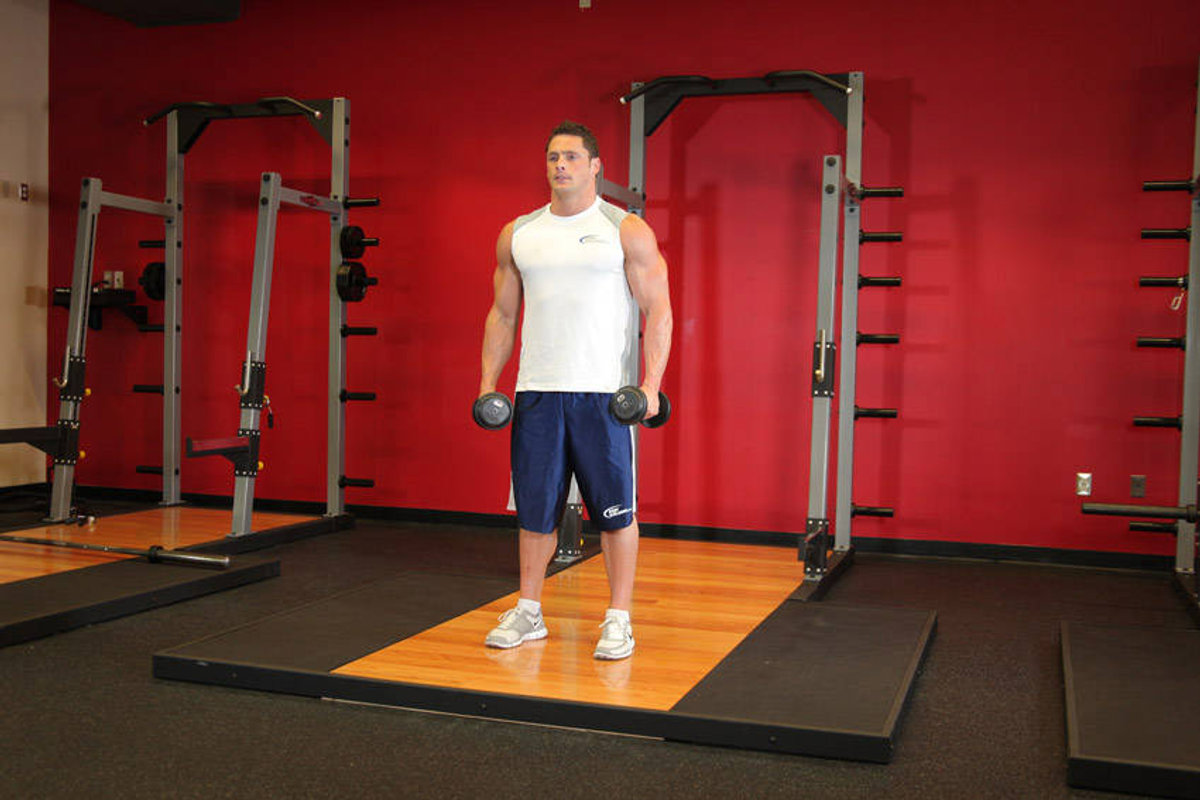
Dumbbell Lateral Raise
Safety Rating for 40+
Benefits for 40+
Lateral raises isolate the medial deltoid effectively with minimal systemic fatigue – ideal for volume accumulation in 40+ with slower recovery. The strict 90° limitation protects against subacromial impingement, the most common shoulder restriction after 40. Light to moderate weights at high volume support tendon health better than heavy single loads.
Form Cues
- Raise arms laterally to shoulder height maximum (90°) – NOT higher
- Slight bend in elbows, thumbs slightly up or neutral
- Lower under control – eccentric phase at least 2 seconds
Common Mistakes
- Raising above 90° abduction – significantly increases impingement risk, especially in 40+ with narrowed subacromial space
- Using momentum from the torso through lateral swinging – reduces muscle stimulus and loads the lumbar spine
- Turning thumbs downward (empty can position) – further narrows the subacromial space
- Choosing weights too heavy – lateral raises are an exercise for control and volume, not maximum load
Modifications
Beginner
Start single-arm on cable or with the lightest dumbbell pair. Perform seated to eliminate momentum.
For Joint Issues
For shoulder impingement: perform in scapular plane (30° forward) instead of strictly lateral – biomechanically much safer. Alternatively: dumbbell scaption as a gentler variant. Limit ROM to maximum 75° if painful.
Advanced
Mechanical drop sets: full ROM to failure, then upper half only (45–90°) to failure. Or: lying lateral raises on an incline bench for altered resistance curve.
Scientific Basis
Primary isolation of the medial deltoid. Research warns: above 90° abduction impingement risk increases. Scapular plane (30° forward) is safer than pure lateral execution. High SFR with light to moderate weights.
Contraindications
- Acute shoulder impingement with pain during arm elevation – test scapular plane as alternative movement
- Acute supraspinatus tendon inflammation
- Severe AC joint arthritis (pain during lateral elevation)
Related Exercises
Related Guides