
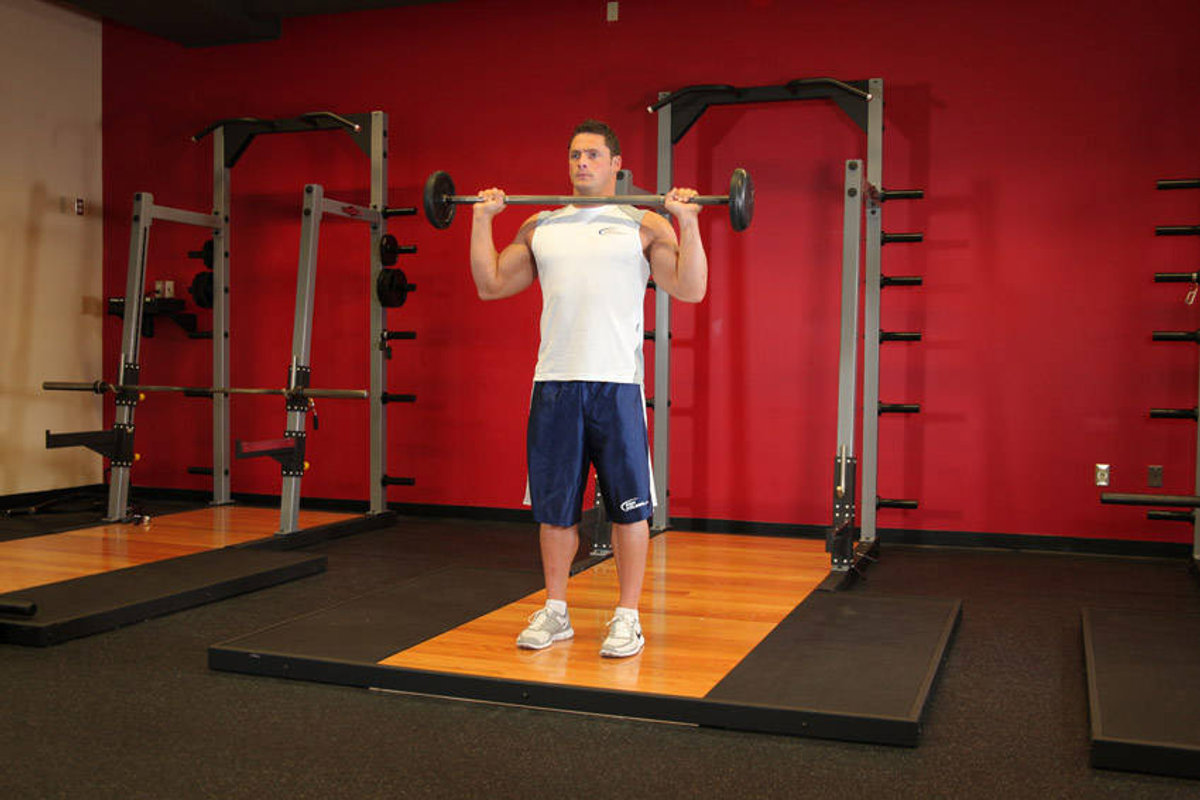
Standing Overhead Press (Barbell)
Safety Rating for 40+
Benefits for 40+
The standing barbell press is one of the most effective exercises for functional upper body strength and full-body stabilization – qualities that become directly relevant to daily life with increasing age (lifting objects overhead, reaching shelves). The high neuromuscular demand stimulates muscle coordination, which declines faster after 40 than pure muscle strength. However, it requires solid technique and adequate shoulder mobility.
Form Cues
- Unrack bar at collarbone height, elbows slightly in front of the bar
- Maximally brace core, squeeze glutes – press bar vertically overhead
- Push head slightly forward once bar passes – keep bar over midfoot
Common Mistakes
- Arching the lower back to move more weight – high risk for 40+ with degenerative disc changes
- Pressing bar in front rather than directly overhead – inefficient and overloads anterior shoulder
- Bringing elbows too far behind the bar – overstretches the anterior shoulder capsule
- Starting without adequate shoulder mobility warm-up – especially dangerous with stiffer joints after 40
Modifications
Beginner
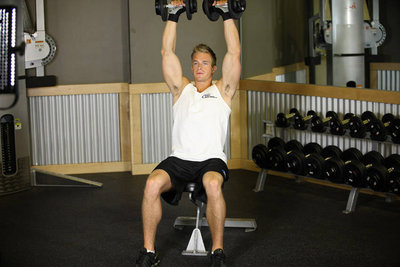
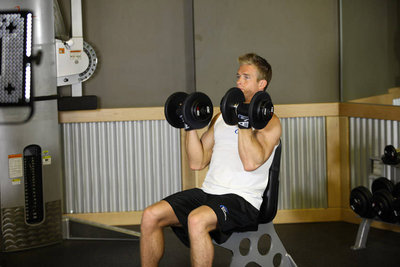
First practice with empty bar, focus on core bracing and vertical bar path. Alternatively build strength first with seated dumbbell press.
For Joint Issues
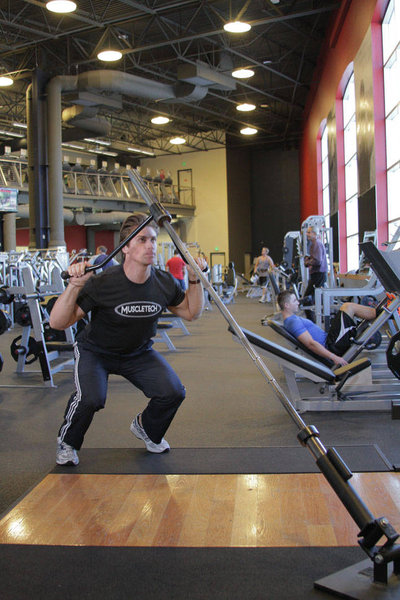
For shoulder impingement: skip this exercise and replace with landmine press. For back issues: only perform seated with back support or switch directly to machine shoulder press.
Advanced
Push press as progression: slight knee dip assistance for heavier loads. Alternatively: pause press with 2-second hold at forehead height for maximum stabilization demand.
Scientific Basis
Classic foundational exercise for upper body strength with high full-body stabilization demand. Research lists standing overhead press as Tier 2 – higher skill requirement and load on lumbar spine and shoulder. Only recommended with solid technique.
Contraindications
- Shoulder impingement – the full overhead position under barbell load is the most demanding shoulder position
- Lumbar disc issues – axial compression under load worsens symptoms
- Limited thoracic mobility or shoulder flexibility (below 170° flexion)
- Rotator cuff instability
- High blood pressure – overhead barbell loading creates significant blood pressure spikes
Related Exercises
Related Guide