
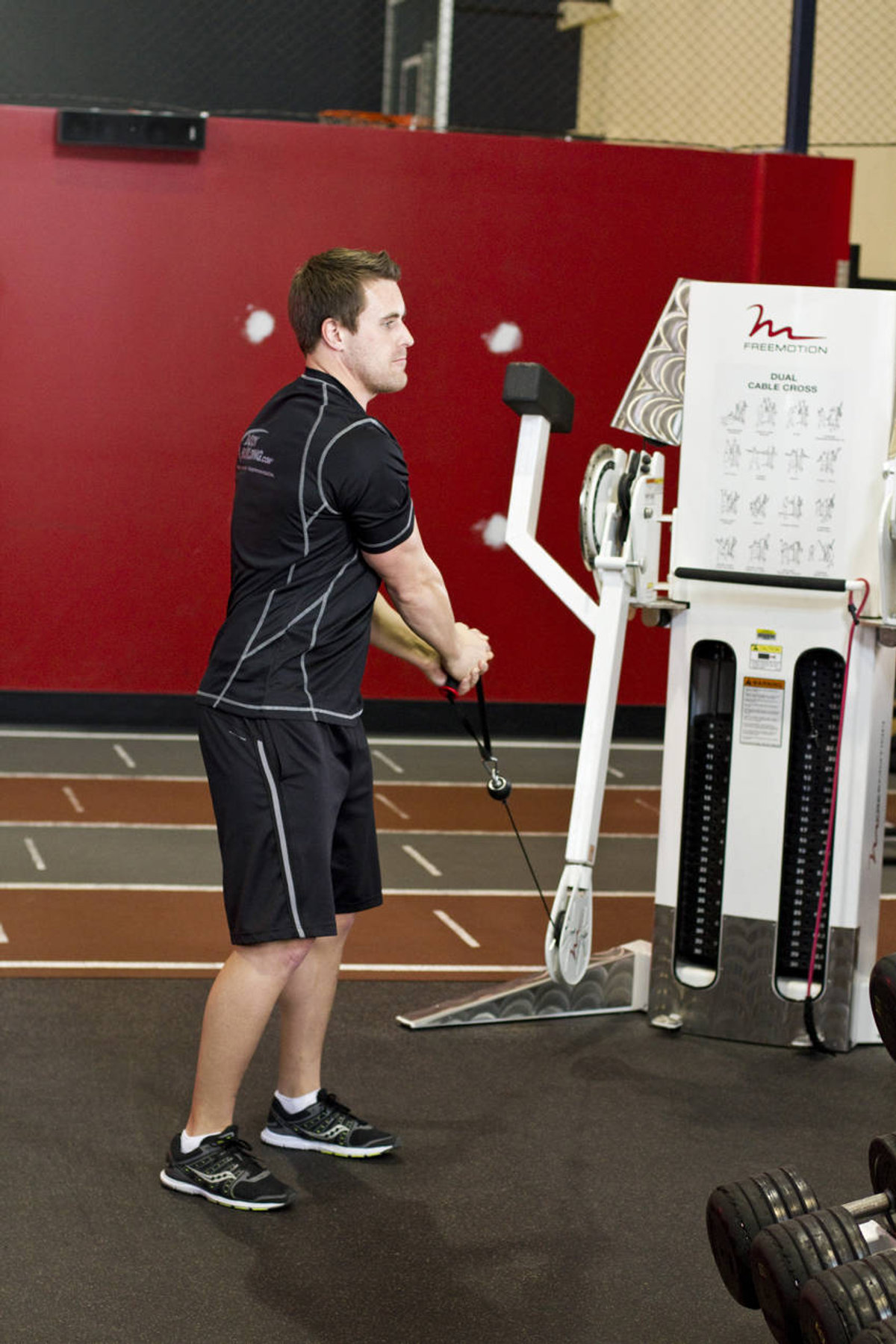
Standing Cable Lift
Safety Rating for 40+
Benefits for 40+
The cable lift is the complementary movement to the wood chop and completes the upward diagonal rotational capability. For 40+, the upward diagonal pattern is especially relevant for daily life: picking objects up from the floor and placing them to the side, lifting children, gardening. These movement patterns become increasingly restricted with age if not specifically trained. The upward movement against cable resistance simultaneously challenges shoulder and trunk stabilizers and promotes upright posture – an important counterbalance to the typical thoracic kyphosis tendency after 40.
Form Cues
- Cable low, stand sideways to tower, grip with both hands
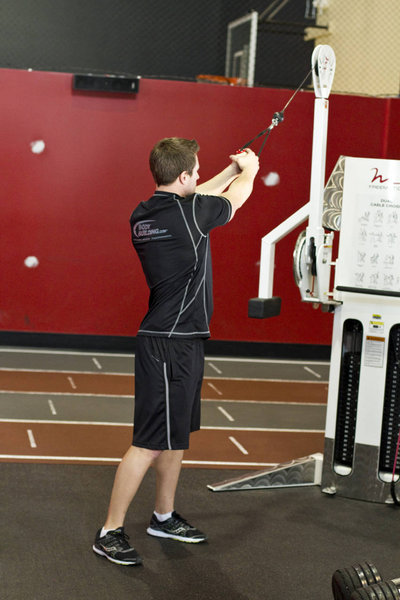
- Lift diagonally up toward opposite shoulder – arms extended
- Same principles as wood chop: rotation from hips/T-spine, L-spine stable
Common Mistakes
- Rotating from the lumbar spine instead of hips and thoracic spine – identical mistake as with wood chop and equally dangerous
- Taking too much momentum from the legs instead of controlled rotation – turns the exercise into a leg exercise rather than core
- Shrugging shoulders at end position – especially problematic for 40+ with impingement tendencies
- Not controlling weight back to starting position – the eccentric phase is equally important as the concentric
Modifications
Beginner
As with wood chop: half rotation angle, light weight, slow tempo. Perform kneeling as an entry variation.
For Joint Issues
For shoulder issues: don't bring end position above shoulder height, keep arms slightly bent. For back issues: minimal rotation, focus on lumbar stability. If painful, switch to Pallof press.
Advanced
Single-leg for maximum stability demand. Combination with wood chop in a superset for complete diagonal rotational coverage.
Scientific Basis
Complementary movement to wood chop: upward instead of downward. Both together cover full diagonal rotational capability. Cable resistance allows precise load control. Functional movement pattern (lifting, throwing).
Contraindications
- Acute disc herniation – rotational loading is contraindicated
- Active shoulder impingement – the upward movement above shoulder height can compress the subacromial space
- Spinal stenosis with pain during rotation or extension
- Acute sacroiliac joint pain aggravated by rotational loading
Related Exercises
Related Guide