
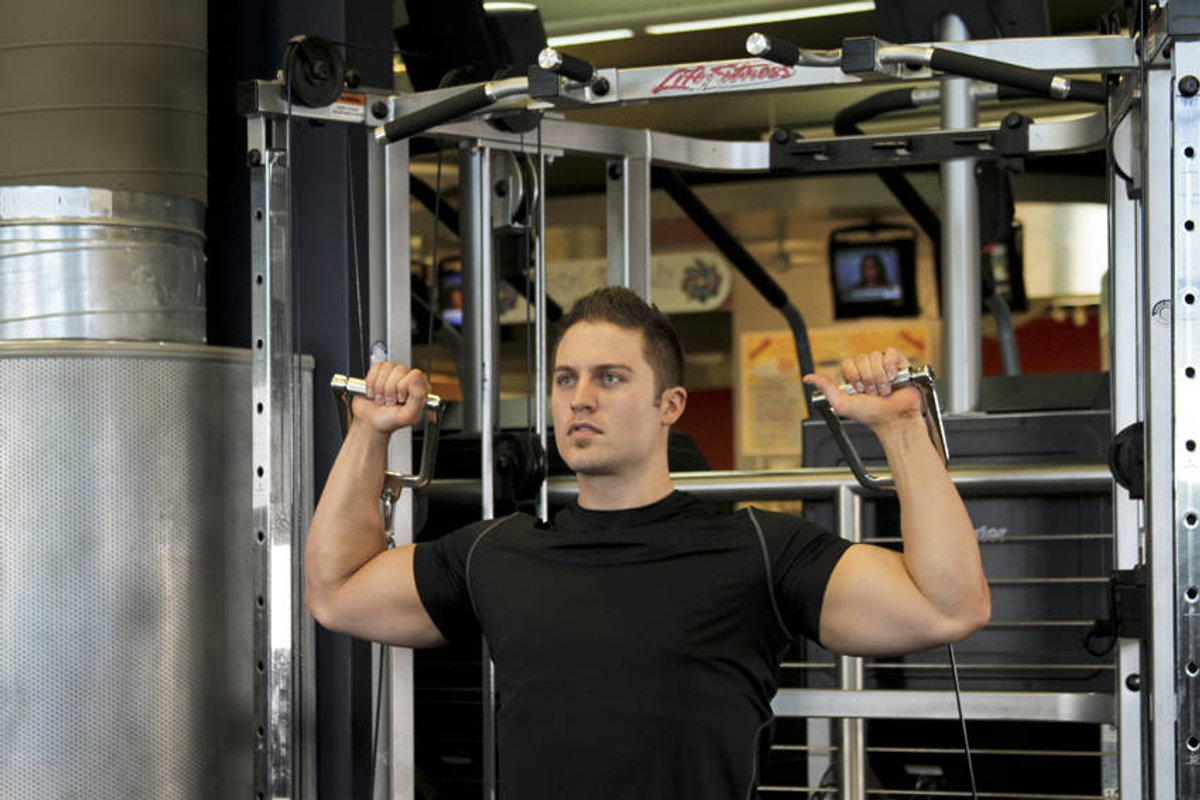
Cable Shoulder Press
Safety Rating for 40+
Benefits for 40+
Cable provides constant resistance throughout the full range of motion – an advantage over dumbbells where tension drops at the top. For 40+ trainees this means more effective muscle building per rep, which optimizes every stimulus given the slowed muscle protein synthesis (anabolic resistance from the fifth decade per Burd et al., 2013). The free handle movement simultaneously allows an individually adapted pressing path.
Form Cues
- Set cables to lowest position, bring handles to shoulder height
- Press upward standing or seated – keep core stable
- Maintain constant tension on the way back down
Common Mistakes
- Setting cable too high – forces the shoulder into an unfavorable starting position
- Leaning torso backward and pressing from an arched lower back – shifts load to the lumbar spine
- Letting weight return uncontrolled – wastes the valuable eccentric stimulus
- Shrugging shoulders up instead of stabilizing shoulder blades down and back
Modifications
Beginner
Perform seated on a bench with back support for maximum stability. Light weight, focus on movement quality and scapular control.
For Joint Issues
For shoulder impingement: position cables laterally instead of frontally, limit range of motion to below head height. Use neutral grip. For back issues: always perform seated with back support.
Advanced
Perform single-arm with slight torso rotation for additional core activation. Alternatively: standing with one foot forward for anti-rotational stabilization.
Scientific Basis
Cable provides constant resistance throughout the full range of motion – unlike dumbbells where tension drops at the top. Excellent middle ground between machines and free weights per research.
Contraindications
- Acute shoulder impingement with pain during elevation above 90°
- Unstable shoulder without medical clearance for overhead loading
- Acute lumbar spine issues (especially in standing execution)
Related Exercises
Related Guide